
15 Mental Models From The World's Top Performers
The most successful people consciously design their mental models. 15 frameworks from Warren Buffett, Jeff Bezos, and Steve Jobs you can install today.

Most people don't know what mental models are running their lives. The most successful people examine theirs constantly.
Mental models are the invisible frameworks shaping how you think and how you make decisions. Charlie Munger built his fortune on examining them. Jeff Bezos built Amazon on a mental model he calls regret minimisation. Steve Jobs designed Apple around a mental model he borrowed from a chemist.
This article gives you fifteen of those mental models, with examples, and the framing for why upgrading them is the highest-leverage thing a high-achiever can do.
What are mental models?
A mental model is a way of thinking that simplifies how the world works.
It's a framework and a perspective you use to interpret information, predict outcomes, and decide what to do next.
You have hundreds of them.
Most you've never examined.
They run your life anyway.
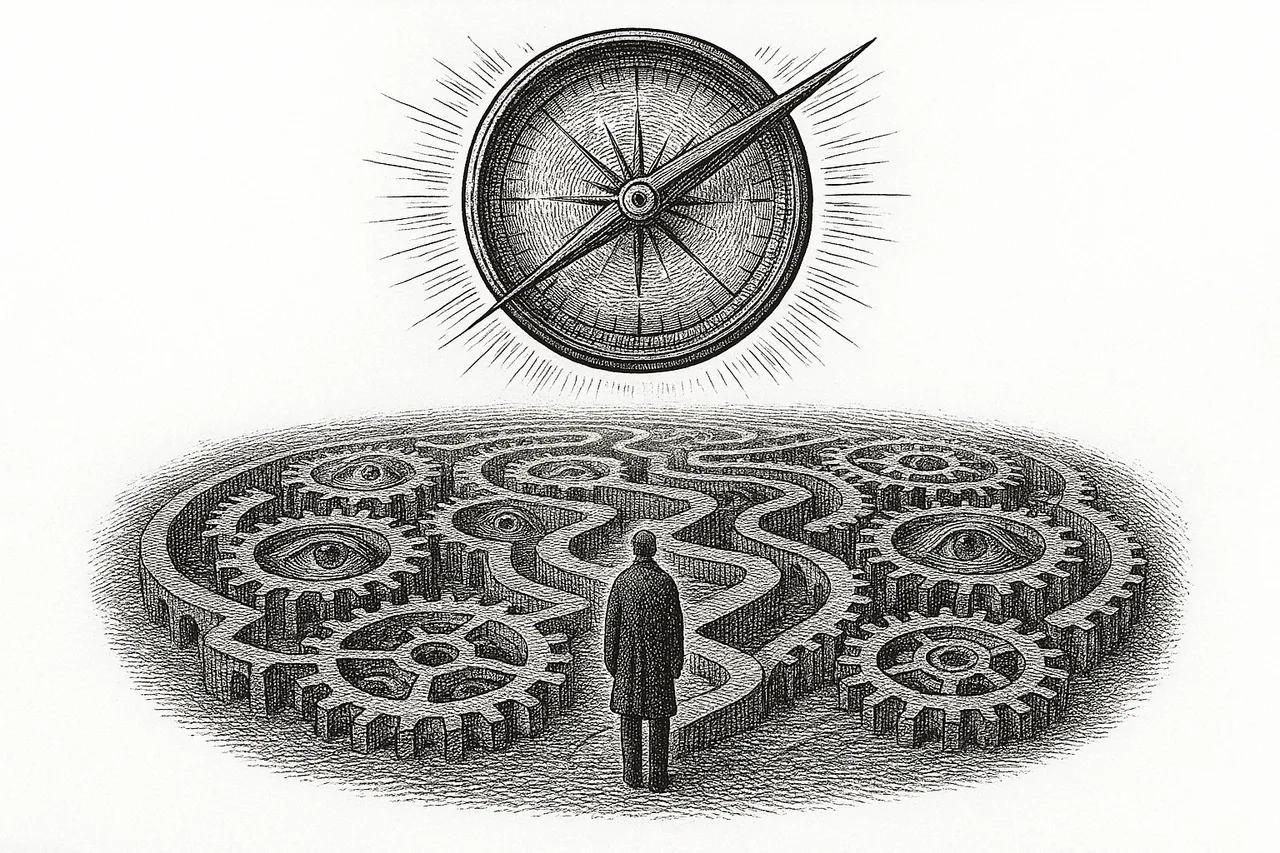
The matrix = your mental models
Think of your mind like a computer. You have programs running in the background.
If I say: "When you're offered a new opportunity, you ____________"
Your unconscious fills in the rest without thinking.
For 15 years, mine was: say yes, afraid I'd miss out.
For the last few, it's been: ask whether it aligns with my one priority this year.
That shift didn't happen by accident. It was a conscious rewrite of the programming.
Most of the time, we don't question and rewrite the code. Your matrix is built from beliefs you didn't choose, rules you never questioned, and programming installed before you knew it was happening. We just keep running the same programs, day after day, year after year, without asking:
Why do I do it this way?
Is this working for me?
Is this even my own programming?
It's not easy.
Questioning everything is exhausting.
It takes energy, time, and mental space.
And if we questioned everything ("Why do I brush my teeth this way?
What are 30 different ways I could brush my teeth?"), we'd never have time for anything else.
We just want one that works.
But everything we've done up to this point, including the most important decisions of our lives, has been built on these mental models.
And just because they've worked up to this point doesn't mean they're good for us. It just means they're familiar.
There's a reason Socrates said "the unexamined life is not worth living." An unexamined life is one where you're running someone else's code without ever questioning if it's yours.
When we make major decisions based on programming installed years ago, without examining whether it still serves us, we stay stuck in the same loops.
If you're not happy with your life right now, it means the mental model you're operating from isn't working.
To get from where you are to where you want to be, you need to change the mental models you're operating from.
As Dr. Joe Dispenza puts it: "You have to break the habit of being you."
What the most successful people know
The most successful people in the world consciously design the mental models they operate from.
They know: the mental models you operate from determine your reality.
Charlie Munger famously said: "If you master 80 to 90 key models, you can improve your thinking and decision-making abilities tremendously. 80 or 90 important models will carry about 90% of the freight in making you a worldly-wise person."
He and Warren Buffett built their entire investment philosophy on consciously examining and adopting mental models from multiple disciplines: psychology, mathematics, physics, biology.
Steve Jobs modelled Edwin Land, the mad scientist founder of Polaroid and a true innovator. Land believed technology should serve human creativity, not replace it. Jobs adopted Land's philosophy of merging art and science, which became the foundation of Apple's design approach.
In NLP, this is called modelling: studying those who've mastered what you want to master, and learning how they think, what principles guide their decisions, what mental models they operate from.
But modelling isn't about copying someone else's operating system. It's about understanding the principles that work and adapting them to fit your reality.
Just because someone is successful doesn't mean their mental model will work for you.
Bezos's relentless customer obsession built Amazon. It would have crushed my soul.
Steve Jobs' relentless intensity built Apple. It would destroy someone who values work-life balance.
So the point is this: understand YOUR mental programming first, so you can decide if it's serving you. Then, if you need to upgrade, you can consciously choose which mental models from others might help.
But you can't skip step one.
You need to see what you're currently running.
And that's harder than it sounds. Because by definition, your unconscious mental models are… unconscious. You're not aware of them. They're just running in the background, shaping your reality without your permission.
If you want to break through your current mental models, you can apply to be a beta tester for the Surreal Guide app. Our AI guide asks the right questions to help you do it.
Mental models vs mindset
People use these interchangeably; they're not the same.
A mindset is your general orientation: growth vs. fixed, abundance vs. scarcity, optimist vs. pessimist. It's the weather of your inner climate.
A mental model is a specific framework for processing a specific kind of information.
Inversion is a mental model.
The 80/20 rule is a mental model.
First principles thinking is a mental model.
You can have an abundance mindset and still operate from terrible mental models.
The successful performer works on both, but mental models are where the highest leverage hides, because they're concrete, swappable, and produce immediately better decisions.
15 mental models to (consciously) try
🔁 The Pareto Principle (80/20 Rule)
80% of your results come from 20% of your inputs.
Example: A business owner might realise that 3 clients generate 80% of their revenue, while 15 other clients drain their energy for minimal return. They're spending 80% of their time on the 20% that barely matters.
→ What's your 20%? What actually moves the needle vs. what just feels busy?
🔬 First Principles Thinking (Elon Musk)
Strip away assumptions. Break things down to fundamental truths, then build up from there.
Example: Most people assume they need to post daily on social media to stay relevant. First principles: Is that actually true? Or is it just what everyone says? Some find their best clients come from word-of-mouth and deep work.
→ What are you building from assumption instead of actual truth?
🔄 Inversion (Charlie Munger)
Instead of asking "How do I succeed?" ask "How would I definitely fail?", then avoid that.
Example: Someone burned out might ask: "What would guarantee I stay miserable?" Answer: keep saying yes to every request, never raise rates, work every weekend. So do the opposite.
→ What would definitely break this? Now do the reverse.
🧓 Regret Minimisation (Jeff Bezos)
Zoom out to age 80. Will I regret not doing this?
Example: Someone terrified to leave their stable career asks: "At 80, will I regret not trying?" If the answer is yes, that clarity often shifts everything.
→ What decision are you avoiding because you're scared, but will regret not making?
📊 The 37% Rule (From Mathematics)
After reviewing 37% of your options, you've statistically already encountered the best one. So choose the best from that first 37%.
Some behavioural scientists say you should apply this to dating. I casually mentioned this to my ex-boyfriend… who has a PhD in mathematics. Let's just say he didn't love being categorised as "part of the 37% sample size." 😬
→ What decision are you delaying (hiring, dating, moving) when you've likely already encountered the right option?
🎯 Circle of Competence (Warren Buffett)
Only invest and operate where you have a real, demonstrable edge. The boundary matters more than the size of the circle.
Example: A founder with deep B2B sales experience launches a B2C consumer app because the market is hot. Six months in, they realise they're competing against people who've spent 15 years studying consumer behaviour. The demand was real, but the founder is not acting within his circle of competence.
→ Where do you actually have an edge, and where are you operating outside it?
🪜 Second-Order Thinking (Howard Marks)
Don't stop at the first consequence. Ask: "And then what?"
Example: A founder considers a 30% price hike to lift margin. First-order: more revenue per customer. Second-order: which customers leave, what they say to their networks, what the remaining customers infer about your brand. The first-order answer is rarely the full answer.
→ For your next big decision: what happens after the first consequence?
📈 Compound Interest
Small inputs, repeated over time, produce non-linear outputs. The trap is that for the first long stretch, the curve looks completely flat.
Example: A founder who writes one essay a week looks indistinguishable from one who writes nothing for two years. By year five, they have a body of work no competitor can replicate.
→ What are you compounding daily that won't show results for 3 years?
⚖️ Opportunity Cost
Every yes is a no to something else. The cost of a decision isn't its price tag, it's the next-best thing you're walking away from.
Example: Saying yes to a six-figure consulting contract costs you the product launch you'd planned that quarter. The dollars are visible. The forgone launch isn't.
→ What's the real cost of your next "yes"?
🛡️ Margin of Safety (Benjamin Graham)
Build the buffer that lets you survive the scenario you didn't model. Don't optimise to the edge of viable.
Example: A SaaS founder runs the company at 18 months of cash, not 6, even though investors are comfortable with the latter. When the funding market shifted, the 18-month founders had options. The 6-month founders had layoffs.
→ Where are you running without a buffer?
🗺️ Map vs Territory (Alfred Korzybski)
Your mental model is a map. Reality is the territory. They are not the same. The danger isn't using maps; it's forgetting they're maps.
Example: A spreadsheet says a customer segment is 40% margin and growing. The map says target it. The territory says those customers churn at 12% per month and your retention model never captured churn. Same numbers, different conclusion.
→ Which of your "obvious truths" is actually a map you've stopped questioning?
🪨 Sunk Cost Fallacy
The money, time, and ego already spent are gone whether you continue or quit. They should carry zero weight in deciding what to do next. Your brain refuses to accept this.
Example: Two years into a business that isn't working, founders often double down because "of everything we've put in." The right question is never "can I justify what I've already spent?" It's "if I were starting today with this information, would I begin?"
→ What are you continuing only because you've already started?
⏳ Parkinson's Law
Work expands to fill the time available. Give yourself a month, the project takes a month. Give yourself three days, it usually takes three days.
Example: A team plans a product launch over six months and spends most of it perfecting the landing page. The same team given three weeks ships a working product, learns from real users, and iterates. The deadline created the focus.
→ Where could you cut your timeline by 80% and still ship?
🎲 Skin in the Game (Nassim Taleb)
Discount the advice of anyone who doesn't bear the consequences. Triple-discount it if they get paid whether they're right or wrong.
Example: A fund manager paid 2% of AUM regardless of performance has different incentives than one paid only on returns. Same job title, different incentive structure, completely different advice.
→ Whose advice are you taking when they pay no price for being wrong?
🪒 Hanlon's Razor
Never attribute to malice what is adequately explained by carelessness, exhaustion, or plain incompetence. Most slights were never personal.
Example: A client doesn't reply for two weeks. Story #1: "they hate the work." Story #2: "they're drowning in their own life." Story #2 is right 95% of the time, costs less energy, and leads to more grounded follow-up.
→ Where are you running a malice story that's probably just chaos?
How to start using mental models today
Pick one of the fifteen above. Just one. Apply it to a current decision in the next 48 hours and write down what changed in how you thought about it.
Charlie Munger didn't get to 80 to 90 models by trying to install them all at once. He got there by being relentlessly curious about which model fit which problem, for sixty years.
If you want to break through your current mental models, you can apply to be a beta tester for the Surreal Guide app. Our AI guide asks the right questions to help you do it.
FAQ
What are the most important mental models to learn?
If you only learn a handful, the highest-leverage are First Principles Thinking (for breaking past assumptions), Inversion (for finding hidden risks), the 80/20 Rule (for prioritisation), Regret Minimisation (for big life decisions), and Compound Interest (for small inputs that pay out non-linearly). The fifteen in this article cover all five, plus ten more from across investing, philosophy, and behavioural economics.
How are mental models different from mindset?
A mindset is your general orientation (e.g. growth, abundance, optimism). A mental model is a specific decision-making framework (e.g. inversion, 80/20, first principles). You can have an abundance mindset and still operate from outdated mental models. They are complementary, not the same thing.
Can mental models be unlearned?
Yes, but slowly. Mental models that have run for decades are deeply grooved neural pathways. The faster shortcut is to add a competing model and consciously choose it in moments of decision until the new one becomes default. Roughly 60 to 90 days of repeated use is when the new model starts firing automatically.
How long does it take to install a new mental model?
Reading about a mental model takes minutes. Installing it (using it under pressure, in real decisions, without prompting) takes 60+ days of repeated, conscious application. The bottleneck isn't intellectual; it's that your existing model fires faster than the new one until repetition rewires that.
Where do successful people learn mental models?
Munger and Buffett famously read 5+ hours a day across disciplines (psychology, biology, physics, history). Most successful performers today combine: deep reading across fields, structured journaling that examines decisions, and time with people who think differently. The point isn't to consume more content; it's to actively examine which models you're using and consciously try alternatives.
Books and podcasts to learn from
A few resources I return to when I want to study how the world's best performers think:
- Tools of Titans by Tim Ferriss. Habits, mental models, and routines from over 200 world-class performers.
- The Great Mental Models by Shane Parrish. The clearest primer on the actual catalogue of cross-disciplinary models.
- Founders Podcast on YouTube. Deep biographies of the founders behind iconic businesses, including the mental models that shaped their decisions.
- r/selfhelp: 30 mental models that will make you more effective. A community-curated thread, useful for browsing the wider catalogue.
Continue the work
This piece is about the what of mental models. The harder question is what's running underneath them: the unconscious programming that decides which models you reach for in the first place.
- Coaching for Entrepreneurs & High Achievers is the broader pillar this sits inside.
- Tap into the Power of the Unconscious for the layer below mental models, where the real upgrades live.
- Self-Development & Personal Growth for the people who've already read the books and want what's next.
With so much love,
Ginny Wan
This post contains affiliate links. As an Amazon Associate I earn from qualifying purchases, at no additional cost to you.
Related
Read next
Coaching for Entrepreneurs & High Achievers
Finding Your Purpose: A Roadmap for Entrepreneurs 2026
Stop searching. This practical roadmap helps entrepreneurs decode their unconscious for finding your purpose. Work with your mind, not against it. Start today!

Coaching for Entrepreneurs & High Achievers
How to Overcome Imposter Syndrome: Creative Minds 2026
Learn how to overcome imposter syndrome. Rewire unconscious patterns with NLP, somatic work, & hypnotic reframes. Practical guide for creatives & entrepreneurs.

Coaching for Entrepreneurs & High Achievers
How to Improve Intuition: A Practical System
Discover how to improve intuition with a practical, science-backed system. Cut through the noise and enhance your decision-making without 'woo' in 2026.