
Feeding Your Demons: A Trauma Release Exercise From Tibetan Chöd
A 6-step embodied protocol for processing the parts of yourself you've been avoiding. From Tibetan Chöd, IFS, and 5Rhythms. Includes safety notes.
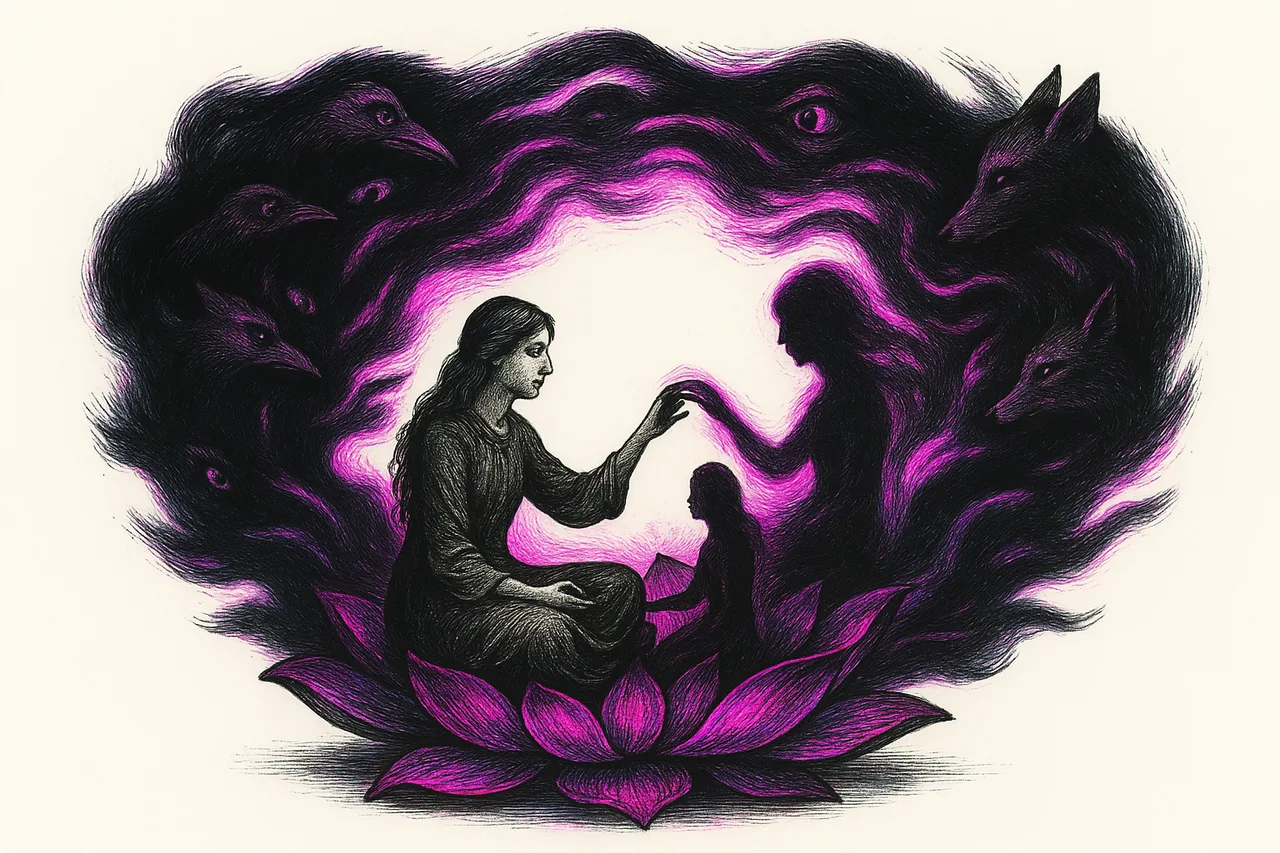
Most trauma release exercises ask you to fight your symptoms. The Tibetan tradition of Chöd does something stranger: it feeds them.
This is a six-step embodied protocol for processing the parts of yourself you've been quietly avoiding: anger, anxiety, addiction, the self-sabotage loop you can't think your way out of. It's drawn from Chöd practice as adapted by Tsultrim Allione in Feeding Your Demons, with elements of Internal Family Systems (IFS) and the embodied work of Gabrielle Roth (5Rhythms) and Ya'Acov Darling Khan (author of Shaman and Movement Medicine). Read the safety notes before you begin.
⚠️ Safety first. This practice brings up intense emotions. Don't try it alone if you're currently in crisis, navigating PTSD or active addiction recovery, or have a history of dissociation, psychosis, severe anxiety, epilepsy, or heart conditions. Take these instructions to a therapist who can hold the space for you. The unconscious is powerful, so respect it.
Watch: the guided Feeding Your Emotional Demons session
If you would rather be guided through the practice than read it, this is the recorded session. I made it for my 7-Day Mindful Phone Use Challenge, so it talks about the emotions that send you reaching for your phone, but most of it applies to any emotion you find uncomfortable: anger, anxiety, shame, grief, the urge to numb out. Put on headphones, find a private space, and follow along.
What is Chöd practice?
Chöd (གཅོད, "to cut through") is an 11th-century Tibetan Buddhist practice founded by the female yogini Machig Labdrön. It uses visualisation, sound, and ritual movement to "feed the demons" (the inner forces that block liberation) until they lose their grip. In modern terms, it's a trauma release exercise that treats your defence mechanisms as parts of you to be understood, not enemies to be conquered.
What is a "demon," really?
A demon is anything that hinders liberation or blocks your inner peace. It's not a Hollywood ghost. It can be triggered by the external world (illnesses, fears, addictions, relationships, family dynamics) or rise from your inner world (grief, anger, anxiety, shame, depression).
These demons aren't your enemies. They are external projections created by the ego to protect you. They exist to keep you safe so you don't have to face what lies behind your worst fears.
In neuroscientific terms, these demons are unconscious neural pathways, the amygdala's way of keeping you safe from vulnerabilities and traumas you've experienced in the past.
My Alcohol Demon
For a long time, I had an Alcohol Demon. It wasn't extreme, but occasionally I would order a bottle of white wine to drink by myself after a long week of work. I didn't know why I wanted it; it was just an automatic behaviour that helped me wind down.
In reality, that Alcohol Demon was guarding against my fear of sitting alone with my feelings. It was protecting me from regressing to the wounded child who had learned that emotions are overwhelming and need to be repressed. It was numbing me so I never had to feel the emptiness that was unconsciously devouring me from the inside.

By facing the fear that the Alcohol Demon was guarding me against, I finally stopped wanting to drink. By learning how to sit with my difficult feelings, I no longer needed to numb them.
Why fighting your demons makes them stronger
Demons manifest as our worst fears. We are evolutionarily wired to avoid what we fear, but the more we avoid our demons, the stronger their control over us. They prey on our fears.
By pushing these parts of ourselves into the shadows, they move into the driver's seat of our unconscious. They start making decisions for us without us realising who is at the wheel.
Most of our decisions are emotionally driven, not logically driven. They are driven by fear, specifically by the avoidance of our inner demons.
So how do we free our demons?
We don't fight them. We feed them.
By identifying the demons of your mind and giving them exactly what they need (whether it's love, safety, recognition, or attention), they lose their power over you. You discover that they are illusionary constructs of your ego, built only to protect you.
This is the practice of Chöd: feeding the demons to cut through the ego.
You don't need significant trauma to have inner demons. They can be everyday fears, patterns, and addictions that are preventing you from reaching your next goal.
While the original Chöd is a lineage practice taught by Tibetan masters, the version below is adapted from my own experience with shamanism, Internal Family Systems (IFS), the work of Gabrielle Roth (5Rhythms), and Ya'Acov Darling Khan (Movement Medicine).
Step 1. List your patterns and fears
Choose one area of your life you want to improve, like career, business, relationships, marketing, public speaking, or parenting. List the patterns and fears that keep showing up when you try to move toward your goal.
For example, my goal is to finish a book.
Patterns getting in my way
- Procrastination
- Perfectionism
- Sudden creative highs followed by resistance to finishing
- Changing the outline again and again
- Productivity highs and lows (swinging between burnout and discipline)
My fears
- Fear of my writing not being good enough
- Fear of working too hard and burning out
- Fear of losing my creative freedom
- Fear of failure and being criticised
Step 2. Identify your demons
For each fear, identify which part of you is driving it.
It might be a past version of you, or just a strong emotion.
Personify it.
Give it a name, a movie character, a colour, or a shape.
Whatever comes naturally.
Tip: start with self-reflection, but if you genuinely struggle, you can paste your Step 1 list into AI and ask it to help identify demon archetypes for you.
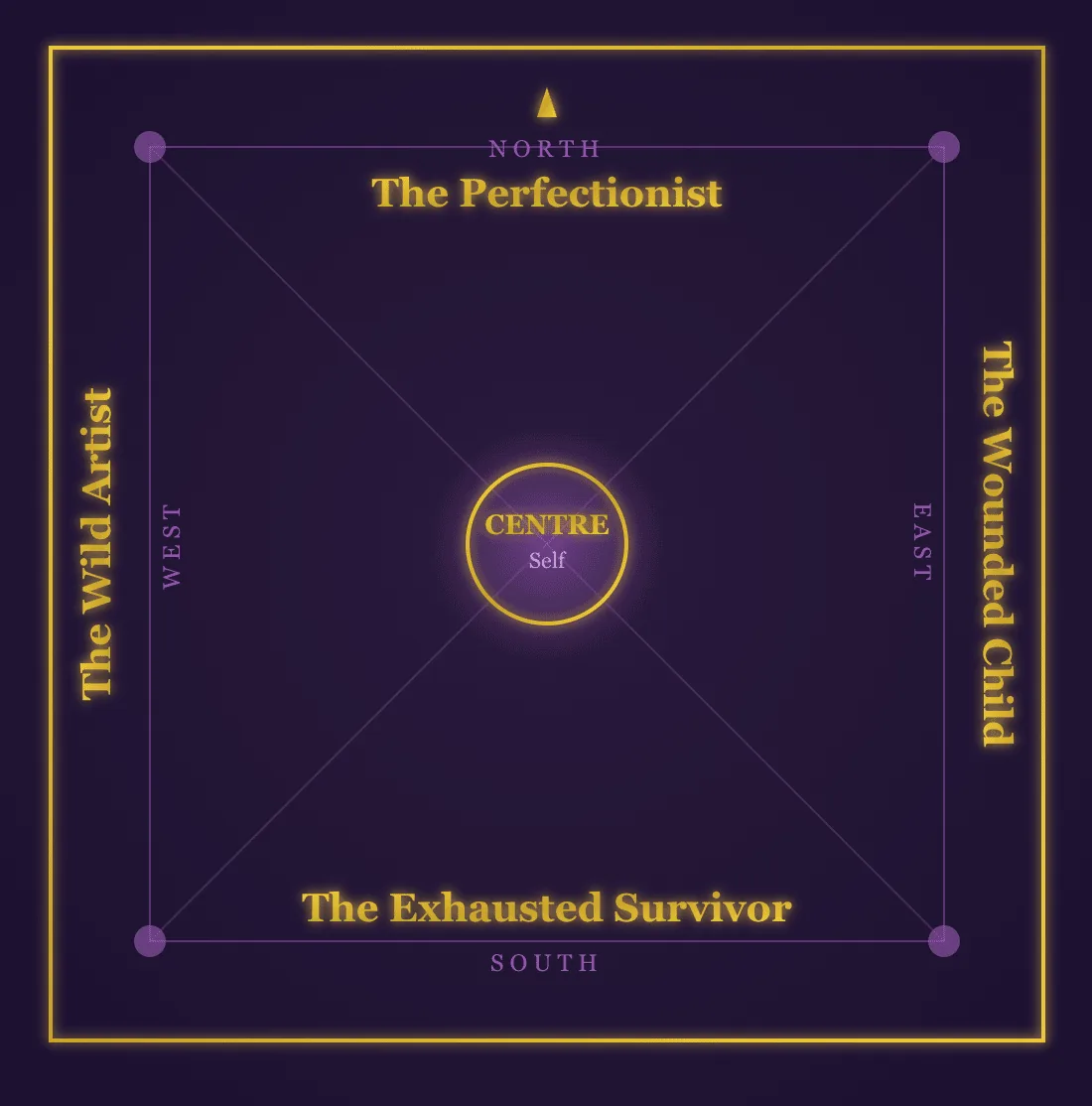
My mapping
- Procrastination + Perfectionism + Endless outlining + Fear of not being good enough → The Perfectionist
- Creative highs + resistance to finishing + Fear of losing freedom → The Wild Artist
- Fear of burnout → The Exhausted Survivor
- Fear of failure → The Wounded Child
- Fear of criticism → The Inner Critic (which sometimes wears the Perfectionist's face)
Step 3. Find the music
Create a playlist (10 minutes minimum) for one specific inner demon. Pick three to four songs that embody that demon's voice.
Spend time finding the right songs. Some people find abstract music without lyrics helps them embody the voice; others need lyrics to tap into the feeling. Trust your gut. When you hear it, you'll feel it.
If you're new to this, just pick one demon to start.
Step 4. Embody the inner demon (the dance)
This practice helps you embody the demon so you can understand what it is trying to protect you from.
Find a private space where you can move freely without judgement. Dim the lights. Give yourself 20 to 30 minutes if you're working with one demon, 1 to 2 hours if you're working with several.
If movement feels unfamiliar, you don't need to "dance" in any formal sense. Stand, close your eyes, and let the music move your body, even if that's just gentle swaying.
Part 1. The embodiment
Start at the centre of the space you've chosen. Ground yourself. Take three deep breaths.
Physically assign a space around you for the demon. Play the playlist and step into that space. Become the demon. If it is the Inner Critic, act as if you are the Critic. Let any memories or emotions emerge without censoring them. Your unconscious knows what you need; surrender and let it move you.
When the song ends, pause. Notice how your body feels. Ask yourself these three questions (answering in the first person as the demon) before stepping out:
- "What I want from you is..."
- "What I need from you is..."
- "When my need is met, I will feel..."
Let the answers come through your body, through sensation, emotion, or movement.
Example: my Anger demon said, "What I want is expression. What I need is attention and recognition of the hurt the inner child suffered. When my need is met, I will feel peaceful."
Step out of the demon's space and move back to the centre.
Part 2. Feed the demon
Back at the centre, take three deep breaths and ground into your body. Turn and face the space where you just embodied the demon.
Visualise giving the demon exactly what it said it needed in Part 1.
If it said "When my need is met, I will feel peaceful," visualise sending waves of peace to the demon. If you find it hard to visualise that emotion, recall a few memories when you felt that specific feeling, and send those memories to the demon.
As you feed the demon those emotions, watch closely: Does the demon's image change? Does it soften? Does it transform?
It might feel weird if you've never done active imagination work before. Don't overthink it. Imagine you are a film director crafting a dream sequence.
Step 5. The final dance
Once you've met the demons, create a final integration dance in the centre. Play a few songs that feel expansive, something that holds space for all of you. As you move, invite your inner demons to dance with you. Recognise that there is no separation between "Self" and "Demon." You are the awareness that holds them all.
When you dance from your wholeness, that is freedom.
Step 6. Journal
While the experience is still alive in your body, write down the embodied wisdom you've gathered.
For each inner demon, capture:
- What it felt like in your body
- What it revealed to you
- What it is protecting you from
- How you can honour it without letting it control you
What to expect
- The first time will feel awkward. Do it anyway.
- Some demons will be hard to embody. Those are usually the ones you most need to meet.
- Emotions will surface, including crying, shaking, or laughing. They are all normal. Let them move through without judgement.
- You might resist certain songs. That is your ego protecting you. Push through.
- After a few rounds, you'll start to recognise the demons immediately, not just in the dance, but in daily life. When the Critic speaks, you'll know. When the Child is triggered, you'll feel it. And you'll finally have the space to choose how to respond.
Watch: a companion to the practice
FAQ
What is Chöd practice in Tibetan Buddhism?
Chöd is an 11th-century practice founded by the Tibetan yogini Machig Labdrön. The word means "to cut through", specifically to cut through the ego's attachment to self by symbolically offering the body as food to the demons (negative forces and obstacles) until they are pacified. The original lineage uses chant, drum, and bell; modern adaptations use movement, music, and visualisation.
Are inner demons real or symbolic?
Both, depending on the framework. In Tibetan Buddhism they are treated as real energetic forces. In modern psychology, particularly Internal Family Systems (IFS) and parts work, they are treated as protective sub-personalities that formed in response to threat. Either way, they behave the same: feed them what they need, and they stop running the show.
Can you do Chöd practice alone?
The simplified version above can be done alone if you are emotionally regulated and not in active crisis. Traditional Chöd is a lineage practice that requires transmission from a qualified teacher. If you're processing trauma, dissociation, addiction, or severe anxiety, do this with a therapist or experienced facilitator rather than alone.
How is "feeding your demons" different from IFS therapy?
Internal Family Systems (developed by Richard Schwartz) and Chöd practice arrive at the same insight from different ends. Both treat your defensive parts as protective rather than pathological. Both involve relating to those parts with curiosity, not opposition. The difference is method: IFS is dialogic and therapeutic; Chöd is embodied, ritual, and rooted in 1,000 years of Buddhist contemplative tradition. Many practitioners use both.
Does this work as a trauma release exercise?
For mild-to-moderate emotional patterns and unconscious blocks, yes, and many practitioners report significant shifts within days. For complex PTSD, dissociation, or active addiction, it should be combined with professional therapy. The somatic dimension (movement, music, visualisation) makes it especially useful for trauma stored in the body that talk therapy alone hasn't reached. If you have a serious trauma history, do not attempt this without professional support.
Watch more
Going deeper
Two books that go deeper into the territory:
- Feeding Your Demons by Tsultrim Allione: the modern Western adaptation of Chöd, with the original five-step protocol that inspired the practice above.
- Shaman: Invoking Power, Presence and Purpose at the Core of Who You Are by Ya'Acov Darling Khan: a deeper exploration of the embodied shamanic work that informs this practice.
Continue the work
This practice sits inside a wider framework. If it resonated, two related explorations:
- Shadow Work & Self Discovery: the broader pillar this practice belongs to. Carl Jung's framework for meeting the parts of yourself you've rejected.
- Stop Overthinking & Quiet the Inner Critic: for understanding the Perfectionist and Inner Critic demons specifically.
If you give this a try, I'd love to hear how it goes for you.
Much love.
Ginny
This post contains affiliate links. As an Amazon Associate I earn from qualifying purchases, at no additional cost to you.
Continue reading
Explore the full Shadow Work: Discover Your Hidden Self pillarRelated
Read next

Shadow Work: Discover Your Hidden Self
The Anger I didn't know I had
Anger doesn't disappear when you suppress it. It stores in the body. A first-person account of finding suppressed anger and the workshop that released it.
Shadow Work: Discover Your Hidden Self
Shadow Work Prompts: 50 Questions to Surface What You've Been Avoiding
Fifty shadow work prompts in eight themes (family, anger, envy, money, desire, intimacy, mortality) to surface what you've been avoiding.