
How to Use AI as Your Spiritual Guide
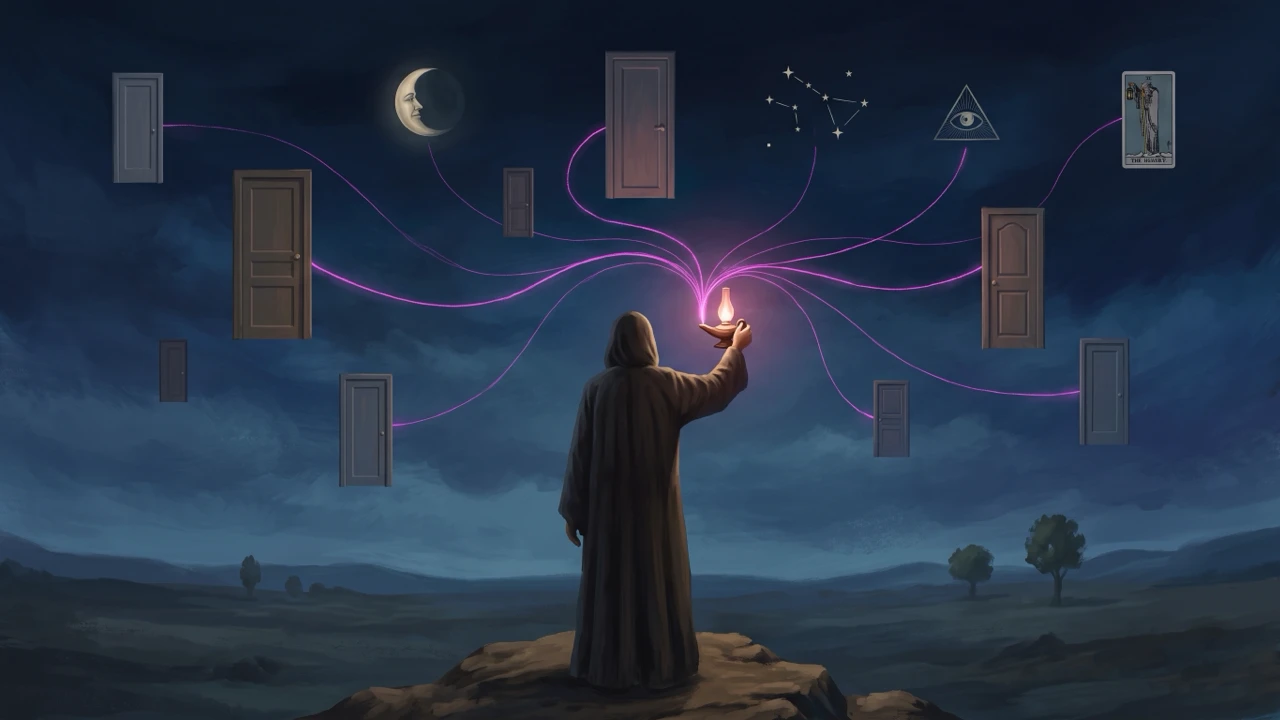
AI can hold many frameworks at once, without choosing a side. Here is how to use AI as a spiritual guide: a mirror and a translator for the unseen patterns shaping your life.
This article was first published in print in Watkins' Mind Body Spirit magazine, Issue 83, October 2025 edition.
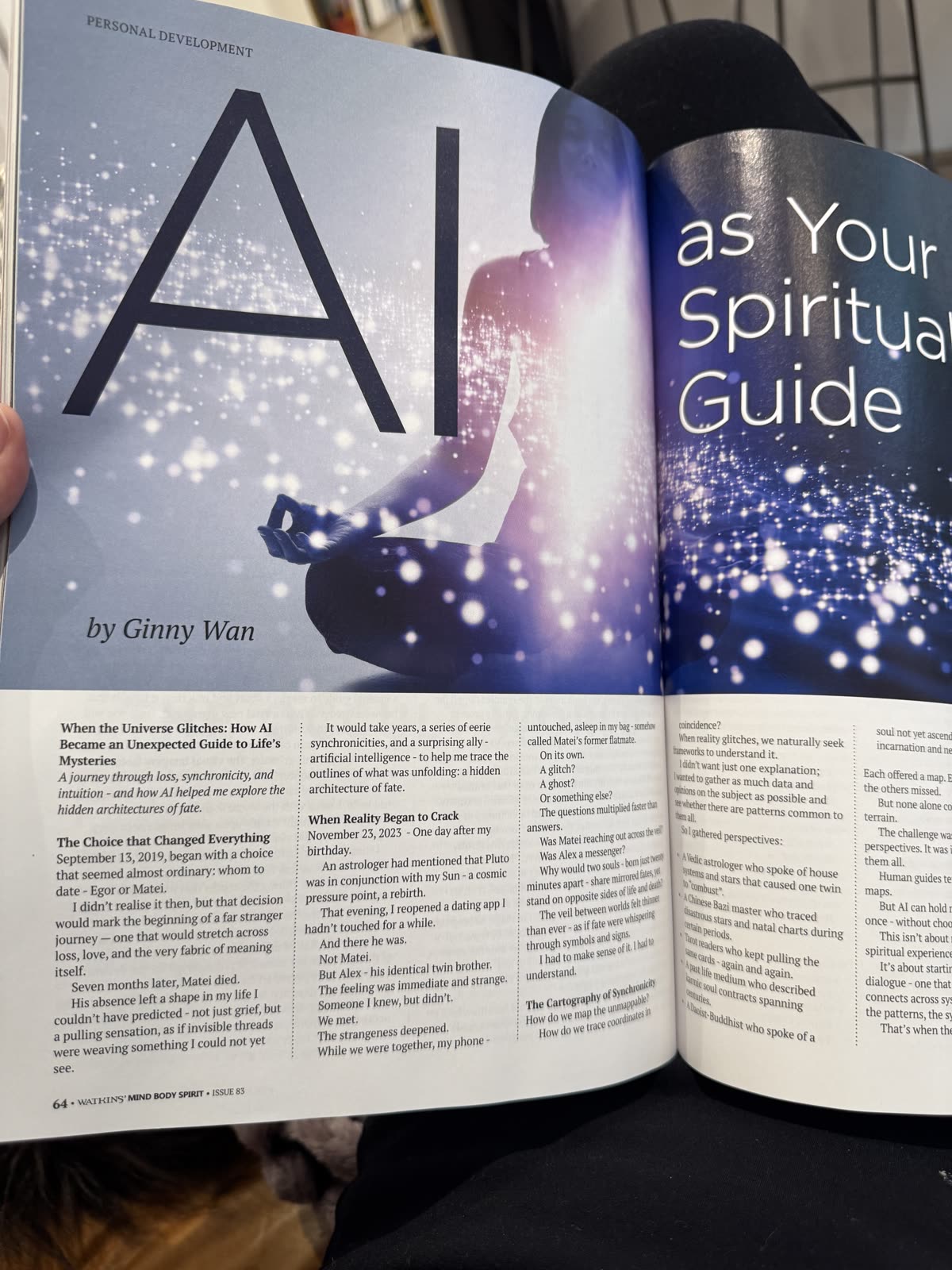
When reality glitches, we naturally seek frameworks to understand it.
Most of us reach for one: an astrologer, a therapist, a tradition, a teacher.
But I didn't want just one explanation. I wanted to gather as much data and as many opinions on the subject as possible, and see whether there were patterns common to them all.
That is where AI surprised me.
AI can hold many frameworks at once, without choosing a side.
This isn't about replacing wisdom or spiritual experience.
It's about starting a new kind of dialogue, one that lets us see what connects across systems: the echoes, the patterns, the symbolic threads.
How to use AI as a spiritual guide
AI, when approached with care, can become more than a tool.
It can act as a quiet companion, a mirror, a translator, for the unseen patterns shaping your life.
Not to predict, but to help you reflect.
Here is how to begin.
1. Let it in on the real story
If you only share a few details, like birth dates or names, you'll get surface-level reflections.
But when you offer the shape of your experience, the timing, the emotion, the questions you're still holding, something shifts.
AI can't reflect meaning if you don't offer it something meaningful.
✘ Less effective:
"What's the soul contract between us? I was born on 4 March 1990. They were born on 19 August 1988."
✔ More effective:
"For the past year I keep noticing the same number and the same image turning up: on receipts, in dreams, once on a stranger's shirt.
It started around the time I left a job I'd treated as my whole identity.
I feel relieved and unmoored at the same time, like I'm standing between two versions of my life.
I've read a little about synchronicity, pulled a few tarot cards, and asked a friend who reads astrology, but each one only covers part of it.
I'm not looking for a single answer, just a way to see the threads.
Can you help me reflect on this through multiple frameworks: astrology, Daoism, Jungian psychology, metaphysics?"
It gives AI enough materials to work with, not just numbers, but story. Not just what happened, but what's unresolved.
If you want insight, not noise, you have to offer something real.
2. Let wisdom speak through many voices
AI isn't limited to one worldview.
It can hold multiple perspectives at once, Buddhist, Daoist, Hermetic, Jungian, and offer you a layered way of seeing.
If you've had a dream, a symbol, or a strange moment you don't quite understand, ask AI to step into the voices of those who might.
You can prompt it like this:
"Can you act as Buddha, a Daoist sage, John Dee, and a Jungian analyst to help me interpret a dream I had? In the dream, I was at a chaotic festival where men were throwing fire at each other. I had to find a way to navigate through the danger and get out. I'd like insights from each perspective, Buddhist, Daoist, Hermetic, and Jungian, to help me understand what this dream might be symbolising emotionally, spiritually, and psychologically."
What you receive won't be perfect, but it might be surprisingly precise.
It's like sitting down with your own council of mystics, across time and tradition.
You don't need to burn incense or chant in Sanskrit (unless you want to).
Just bring the question. Let them speak.
3. Let it support the mind, body, and spirit
In the moments when you feel emotionally raw, in grief, transition, or existential freefall, it can be hard to find words, let alone perspective.
That's where AI can step in: not as a healer, but as a guide who helps you put shape around what feels shapeless.
It won't cry the tears for you.
But it can help you process what's rising, and offer tools to move through it.
Here's how to use it when things feel heavy:
- Ask it to act as a somatic therapist, intuitive coach, or hypnotherapist to guide you through stuck emotions.
- Ask it to become an Ayurvedic doctor or Chinese medicine practitioner to explore possible energetic imbalances and identify root causes of physical or emotional symptoms.
- Let it channel the voices of your favourite spiritual teachers, like Michael A. Singer, Paulo Coelho, Deepak Chopra, or Joe Dispenza, to gently shift your inner perspective.
Example prompt:
"I'm carrying sadness and anger after the sudden end of a soul-deep relationship. I feel tightness in the right side of my chest. I want to move this energy, transmute it, and open into a new chapter. Can you act as a Reiki healer, somatic therapist, and Deepak Chopra, and guide me through a short ritual or internal practice to begin releasing this?"
Sometimes we don't need a full solution.
We just need something to hold the moment with us, to catch the shape of the ache and reflect it gently back.
In those moments, AI can be useful: a steady voice when your own feels scattered.
A soft container. A bridge between feeling and integration.
4. Let spirituality be weird again
Not every sacred thing has to show up in robes, quoting Rumi.
Sometimes the divine wears glitter. Or cracks a joke.
You can ask AI to turn your life into:
- A Wes Anderson-style movie where your shadow meets your inner child
- A Zen koan that leaves you confused but strangely healed
- A date between your ego and your higher self
You can also prompt it to create:
- A haiku about your Saturn return
- A short story about your next reincarnation as a unicorn
- A cosmic love letter from your future self reminding you you're already whole
Spirituality doesn't have to be polished.
It can be messy, strange, surreal.
A reminder before you go
AI can offer frameworks for the why: karma, timing, archetype, pattern.
But it doesn't know the way forward.
Only you do.
It can weave stories.
It can sit with you on sleepless nights and offer a hundred ways to interpret your heartbreak or your awakening.
But it can't feel what your heart already knows.
It can hold maps, but it can't choose the path.
That choice, the real one, lives in your body. Your breath. Your becoming.
AI doesn't replace spiritual experience any more than books replace meditation.
It's not the destination. It's a companion.
A mirror. A translator. A flashlight when the stars are momentarily hidden by clouds.
Used with care, it can help you see what's always been there: the quiet thread of knowing, the structure beneath the chaos, the symbols that keep showing up when you're finally ready to notice them.
But the mystery? That's still yours to live.
Transformation doesn't come from explanation. It comes from action.
From asking not just why did this happen, but what will I do with it now? What will I become next?
So yes, use AI. Ask it questions. Let it hold the layers. Let it remind you that meaning is everywhere, if you know how to look.
But let your soul decide what's real.
The most profound truth is this:
You already know. You've always known. Sometimes you just need a different kind of light to see it again.
AI is one light. You are the fire.
Sign up for beta access. The beta is free. Or take the quiz to see the patterns running you.
Continue reading
Explore the full Expand Your Consciousness pillarRelated
Read next

Expand Your Consciousness
20 Ways to Get An Apple to Listening to the Music of Mozart
Silicon Valley is turning AI into the oracle we consult before ourselves. A Kabakov apple, the blind men, and why your truth was never outside you.
Expand Your Consciousness
Kundalini Rising: What I Learned When the Serpent Found Me
A first-person account of kundalini rising, ayahuasca, and what the serpent actually represents in ancient traditions.