
Speaking Your Truth: Why the Ancient Egyptians weighed hearts, not brains
The ancient Egyptians weighed hearts against truth. Their ritual hides a modern lesson about authentic voice in the age of AI and copy-paste content.
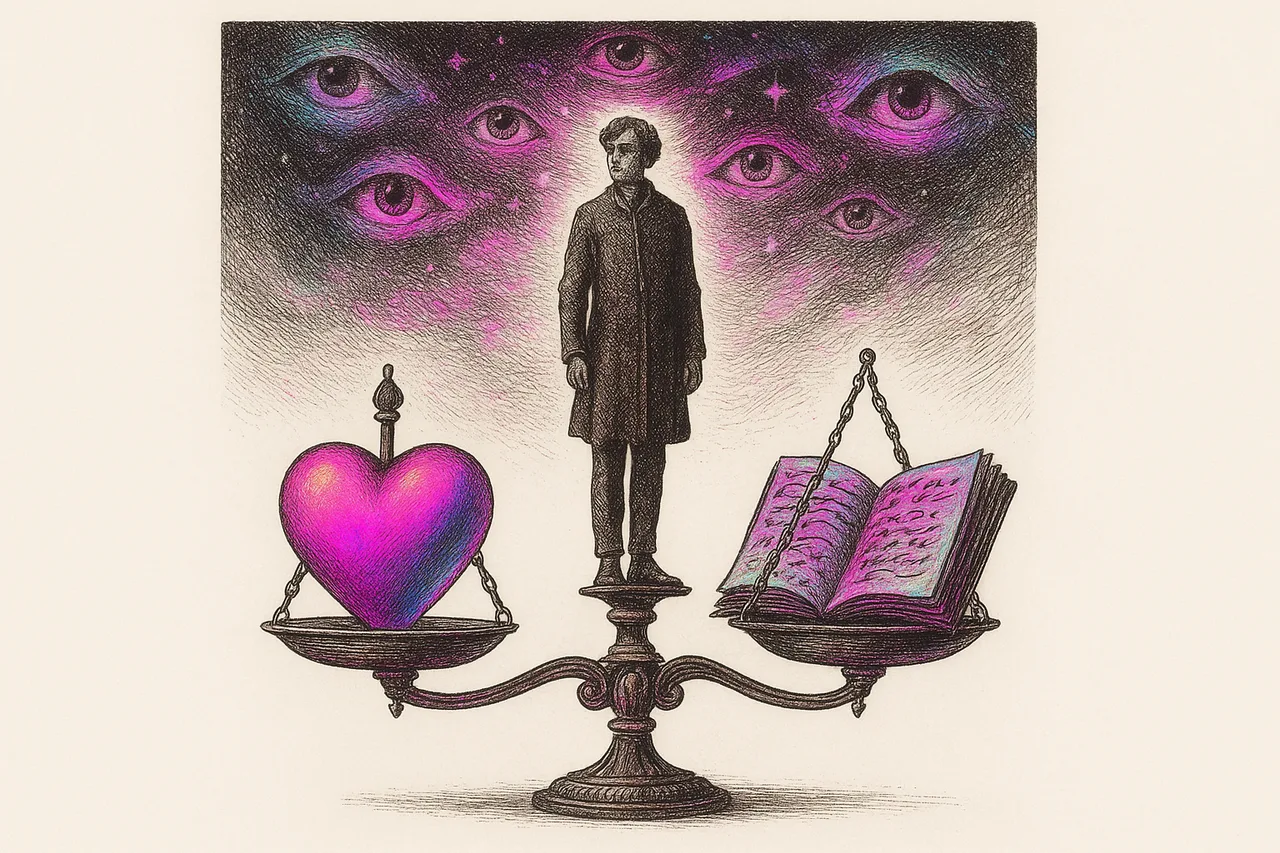
Speaking your truth has become harder than ever. AI offers to write your next sentence for you. And underneath all of it, a quiet question persists: when did I last say something that was actually mine?
The ancient Egyptians had a phrase for this. They took the claim seriously enough to test it after death.
The Weighing of the Heart
On Ancient Egyptian tombstones, you can find one common phrase:
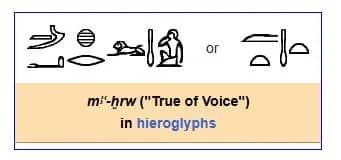
It meant that this person had lived true to their voice throughout their life.
Whether they had indeed lived their truth was tested through a ritual called the Weighing of the Heart, as recorded in the Egyptian Book of the Dead.
When a person died, their heart was weighed against the feather of Ma'at: the cosmic moral order, the universal principle of truth and balance.
If the heart was as light as the feather, the soul passed. They were said to have lived "True of Voice," and were allowed to enter the afterlife.
If the heart was heavier than the feather, weighed down by lies, betrayals, and lives lived in someone else's voice, it was devoured by Ammit, the demon of inauthenticity, and the soul ceased to exist.
What "True of Voice" really meant
But what did "True of Voice" really mean to the ancient Egyptians?
It meant that you had acted in alignment with your own truths. You spoke your truth. Not the truth of others, not what society prescribed, but the truths that lived in your own heart.
Five thousand years later, this ancient test feels more relevant than ever.
Why this is harder in the age of AI
In an age of AI, algorithms, and copy-paste marketing strategies, it's never been easier to not be true to your voice. To let the machine or your competitor speak their truths through you.
I've been guilty of it too. Times when I borrowed someone else's template. Times when I let a machine write the next sentence. Because it was the easy thing to do.
And when we're tired, overwhelmed, or burned out, "easy" is tempting.
But just because it's easy doesn't mean it's true.
Or right.
Or yours.
What blocks your authentic voice
The reasons we don't speak our truth tend to come down to a handful of fears, all wearing different costumes:
- The fear of being misread. Your truth has nuance. In public, that nuance gets compressed into something simpler and often something wrong.
- The fear of disappointing people who knew the old you. Finding your real voice usually means outgrowing an identity others have grown attached to.
- The fear of being wrong out loud. A template can't really be wrong because it doesn't quite say anything. A first-person sentence carries actual risk.
- The fear of not being liked. Likability is the polish left behind after you've sanded off anything that might land badly.
- Burnout. When you're depleted, copy-pasting someone else's words is genuinely cheaper than finding your own.
- Not actually knowing what your truth is. This one is the quietest. After enough years of performing other people's voices, you can lose track of your own.
Being true to your voice is hard. You will be misunderstood and criticised. People might think you're too weird or too much.
And sometimes, your authenticity will make other people uncomfortable.
Because when you speak your truth, it reminds others that they aren't speaking theirs.
How do you speak your truth?
Speak from your heart, not from your mind.
Your true voice doesn't live in the mind. It lives in the heart.
Your mind can lie, but your heart always knows what's true.
That's why the Egyptians weighed the heart, not the brain.
Maybe this ancient culture, with over 3,000 years of history, where people spoke Medu Netjer, the language of the Gods, knew something we've forgotten.
In their language, words weren't just communication.
They were frequency. Vibration. Power.
Each offering to the gods began with voice, spoken aloud.
Voice was sacred.
And so, in this AI age, where it's so easy to speak with someone else's voice, I invite you to do the opposite.
Speak your truth.
Speak what your heart wants to say.
Speak what your soul already knows to be true.
Live "true of voice."
It may be the hardest thing you do.
It may also be what sets you free.
A practice for finding your true voice
The Morning Pages practice from The Artist's Way by Julia Cameron is a great place to start. She suggests that as soon as you wake up, you write three pages in your journal in stream-of-consciousness style, without censoring any thoughts. Many creatives and entrepreneurs swear by it, including Tim Ferriss and Alicia Keys.
According to neuroscience, when we've just woken up, our brain is still in a liminal state between the conscious waking state of Beta and the dreamier states of Delta and Theta. This is when the brain is naturally in an altered state of consciousness, and when insights from our unconscious are most likely to surface.
If you can schedule 30 minutes to journal in the morning before your conscious mind takes over the day, you might start to hear the whispers of your soul. Gradually, you can discover what your true voice actually sounds like.
A practice for not losing your true voice when using AI
Speak or write your own opinion first. Instead of asking AI to write everything out for you, draft your own version first, or transcribe your thoughts about the article by speaking them out loud. Your unedited voice is the raw material. Only use AI to edit it, not to create it.
Think through your arguments yourself, instead of asking AI to do the dirty work. A recent MIT study found that students who used ChatGPT to write essays couldn't recall what they had written. Their brains became weakened as a result. Don't outsource your critical thinking to AI.
Use AI for editing grammatical mistakes and polishing the flow. Treat it like a copy editor to check your finished draft for typos, awkward phrasings, and logical flow. Then read every sentence aloud and ask: would I actually say this?
Use AI as a thought partner to challenge your thinking. Ask AI to act as a thought partner or devil's advocate. Tell it to ask you one question at a time and challenge what you think. This keeps your critical thinking active instead of letting AI replace it. You can also apply to be a beta tester for the Surreal Guide app, where we've programmed the AI to challenge your thinking and help you expand your consciousness.
FAQ
What does "true of voice" mean in ancient Egyptian?
"True of voice" (Maa-Kheru) was the verdict given to a soul that had lived in alignment with truth and cosmic order (Ma'at). It appeared on tombstones as a declaration that the deceased had spoken and acted truthfully throughout life. It was the highest moral standard in Egyptian culture for over 3,000 years.
What was the Weighing of the Heart ritual?
The Weighing of the Heart was an Egyptian funerary ritual described in the Book of the Dead. The deceased's heart was weighed on a scale against the feather of Ma'at (truth). If the heart was as light as the feather, the soul passed into the afterlife. If heavier, weighed down by lies and inauthenticity, it was devoured by Ammit and the soul ceased to exist.
How do I know if I'm speaking my truth?
Two reliable tests: (1) does the way you speak in public match the way you speak in private with people you trust? (2) Do you feel a quiet relief after speaking, or a tight, performative residue? Truth has a somatic signature, and it often feels grounded and centred as you speak it. Inauthenticity has its own somatic signature, and it often feels contractive and shaky.
Can AI undermine authentic voice?
It can. If you outsource your truths to AI, you start sounding like everyone else. Used as a thought partner, it can free up your time. But when used as a substitute for your own thinking, it slowly erodes the very muscle that makes your voice yours.
Continue the work
This piece is about voice as the surface of the deeper question, what is your truth, and what does living in alignment with it actually require?
- Find Your Purpose & Meaning, the broader pillar this sits inside.
- Tap into the Power of the Unconscious, for the layer below conscious truth, where the older voice lives.
- Expand Your Consciousness, for the contemplative traditions that have been asking these questions for millennia.
With love,
Ginny
Continue reading
Explore the full Find Your Purpose and Inner Truth pillar