Why High Achievers Self-Sabotage (And the Meta-Problem Behind It)
Most self-sabotage advice fails because it treats the symptom. The Meta-Problem framework finds the unconscious belief actually running the loop.
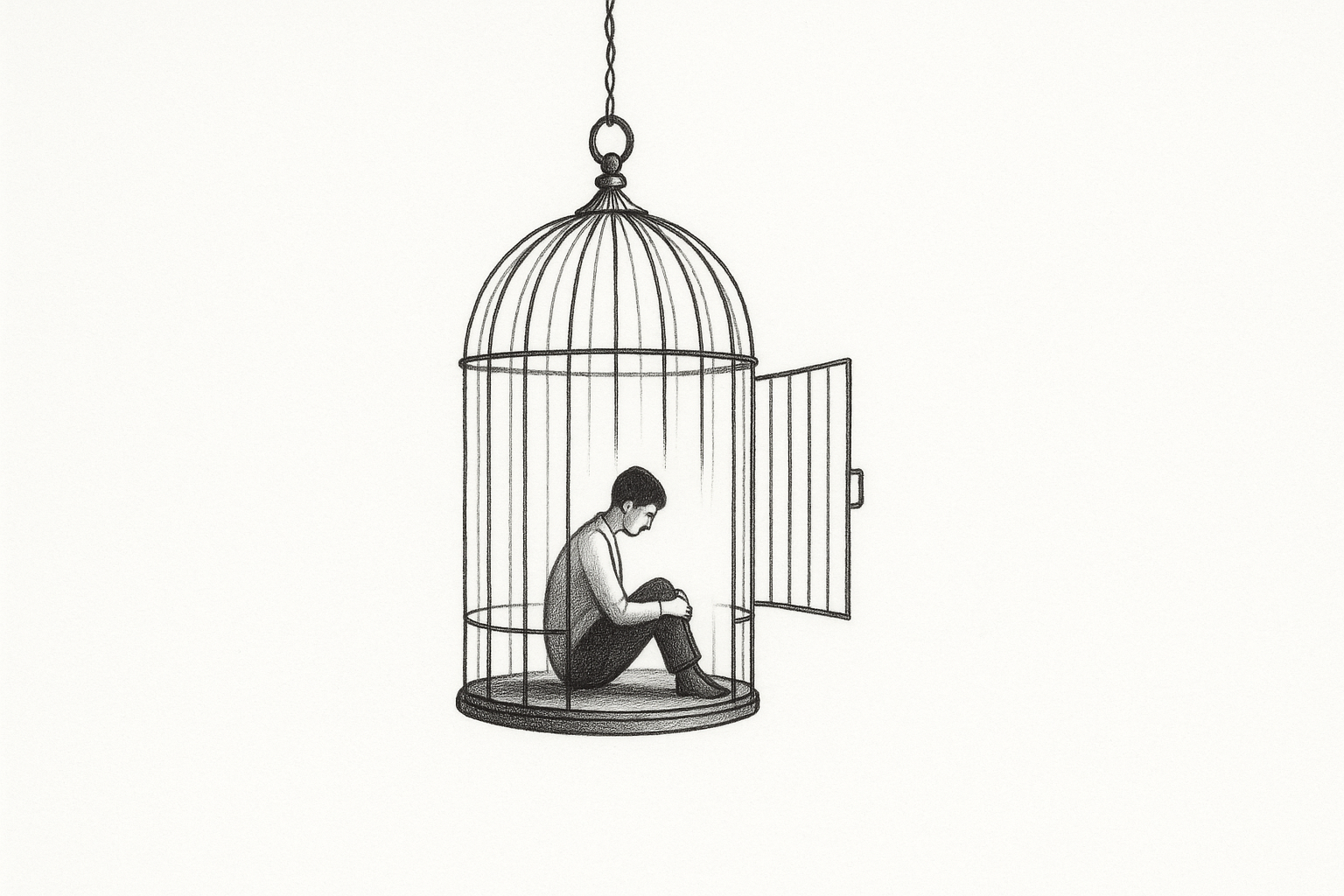
Most people picture self-sabotage as missed deadlines and self-destructive behaviour. For high achievers, it looks like the opposite: grinding harder, optimising more, and quietly running a business model that is slowly destroying you.
Self-sabotage is the unconscious mind protecting old wounds at the cost of new growth. The advice industry treats the symptoms — discipline hacks, time blocks, mindset reframes. None of it works for long. Because the problem isn't where you're looking.
This article is about the Meta-Problem — the problem behind the problems — and how to find yours.
What is self-sabotage in business?
Self-sabotage in business is the gap between what you consciously want and what your unconscious will allow. It shows up as procrastination on visibility, undercharging, over-delivering, hiring late, or building a business model that requires you to be needed every hour of every day. The behaviour looks irrational. The unconscious logic underneath it is airtight.
The Meta-Problem: the problem behind the problems
I used to go to Amsterdam once a year for a "mind pilgrimage." Just me, a notebook, a small dose of psilocybin, and a list of high-level business and personal questions designed to identify my bottlenecks and growth ceilings.
In 2023, I brought ten questions about scaling my business and finding blind spots in my own and my clients' marketing campaigns.
By the end of that four-hour journey, every question was answered — though not the way I expected.
Because I had been asking the wrong questions altogether.
The real problem was invisible. It was buried under years of "doing the right thing."
It was the Meta-Problem — the problem behind the problems:
Why did I choose this specific business model?
As the logic fell away, I wasn't in Amsterdam anymore. I was fourteen. Alone. Newly arrived in a foreign country with a suitcase full of clothes and an identity not yet formed. The escape was necessary — a flight from years of abuse in a household that was not safe to stay in. I arrived with no family, friends, or acquaintances who knew who I had been before. I did not know the rules. I did not know that smiles were not always invitations, or that friendliness did not mean belonging.
I was never quite seen. So I tried to earn it. I decided to smile more and please more. I had to be useful, and maybe then they would be nice to me.
Beneath that memory of the fourteen-year-old lay a dense, heavy feeling just below my chest. It was the physical sensation of a void that needed to be filled constantly — a cold, bottomless fear of abandonment that had no face and no name. I couldn't consciously recall it, but I eventually understood through years of talk therapy that it was the dread of a toddler being sent away to a boarding kindergarten at the age of two and a half.
The fourteen-year-old was just trying to manage that fear through people-pleasing. She was reacting to a void that had been there all along, unconsciously believing: "If I have something to offer, people will keep me. If I make myself indispensable, I will finally belong."
That terror had been the architect of my life and my business.
My unconscious chose the agency and coaching model for me because a scalable digital business does not always physically "need" me.
In an agency, my worth was validated in every call, every crisis solved, every "thank you, I couldn't have done this without you."
And if I'm not needed every hour of every day, how do I know I'm worthy of existing?
I had commercialised my people-pleasing, and I was paying the price for it in energy, health, and time.
Shedding that identity was not easy. The ego wants to cling to what has defined us.
But as I gradually became more conscious of these patterns, I was finally able to bypass my growth ceilings. I shifted to a digital model that allowed me to double my revenue while working much less. I was setting boundaries, attracting respectful clients, and I thought I was finally stepping into my own power.
But I didn't realise there were deeper unconscious beliefs still influencing how I ran my life.
"Money is emotional debt"
About a year later, I sat in a workshop with Paul McKenna, one of the UK's top hypnotherapists. He asked us to finish a sentence without thinking.
"Don't censor your thoughts. Just write down whatever comes to your mind first."
The prompt was simple: Money is _______.
My pen moved before my conscious mind could intervene: Money is emotional debt.
I stared at the words for a long time. I hadn't realised I'd been carrying this belief my whole life.
Growing up, I watched money move through my family with strings attached. My father was a lawyer and an entrepreneur; my mother stayed at home. When she received money, she owed him something in return — attention, compliance, gratitude. Money was never just money; it came with a claim on her soul.
I had carried this belief into my business without knowing it. Every time a client paid me, I felt indebted. Payment was an emotional loan I had to repay by overdelivering and saying yes when I wanted to scream no. It explained why I chronically underpriced my offers.
Paul McKenna gave us a second prompt: "To make more money, I need to _________."
My answer: to make more money, I need to work harder.
That belief came from my Asian upbringing, where hard work was the price of existence. If I didn't get the grades, I was "useless" and "worthless." In childhood, success was measured by grades. In adulthood, it became net worth. Advertising around us unconsciously installed the equation that self-worth = net worth, and if you can't afford the Chanel bag or the Ferrari, you aren't enough.
These two beliefs locked together to form a prison.
If money is emotional debt, being paid creates a burden. If money requires working harder, the only way to alleviate that burden is relentless effort.
The more I earned, the more I felt I owed. The harder I worked, the more trapped I felt.
I was still optimising a cage.
Why this happens: the first 7 years
We spend so much time thinking through our problems consciously, but we never look at the unconscious architecture that actually decides our business models, our prices, and the ceilings we inevitably hit.
It is difficult to see outside the box when you are living inside it.
The construction of your "box" happened during the first seven years of your life, when your brain was in a natural Theta state — a hypnotic frequency where you were effectively hypnotised into a reality you didn't choose, absorbing the beliefs and fears of the world around you without a filter.
And you've been running that same software ever since.
If those beliefs were programmed in, they can also be de-programmed. But awareness is the first step: seeing what's actually driving your decisions.
How to find your own Meta-Problem
You can do a stripped-down version of the diagnostic alone. Take a notebook. Pick one area of your business that has been stuck for more than a year — pricing, hiring, scale, visibility, sales. Then complete each of these sentences without thinking:
- Money is _______
- To make more money, I need to _______
- If I succeed at the next level, I will lose _______
- I chose this business model because _______
- The version of me that built this business believed _______
Don't censor. Don't make it sound smart. The first answer is always the most honest one.
Then ask the harder question: whose belief is this, originally?
If it's not yours — if you can trace it back to a parent, a teacher, a culture, a fourteen-year-old version of you trying to belong — that's the Meta-Problem. That's what's actually running your business.
The truth might be brutal. It will definitely be uncomfortable. Your ego will want to grip the reality you've been in for a long time, telling you these beliefs are "facts" rather than limits. That resistance is just a protective mechanism — a younger version of you trying to keep your world safe.
Notice the resistance. Then keep going.
FAQ
Why do high achievers self-sabotage?
High achievers self-sabotage because the unconscious mind learned somewhere along the way that success is dangerous — that visibility costs, that being needed equals being safe, or that earning more requires earning it through suffering. The pattern wasn't installed because you are weak. It was installed when you were a child trying to survive a specific environment. Your nervous system kept the rule. The rule now runs the business.
What's the difference between self-sabotage and burnout?
Burnout is the body's collapse from sustained stress. Self-sabotage is the unconscious behaviour that creates the stress in the first place — saying yes when you should say no, undercharging, over-delivering, building a model that requires you to be needed. Burnout is downstream. Self-sabotage is upstream.
How do you stop self-sabotaging your business?
You stop by surfacing the unconscious belief running the pattern, not by adding more discipline on top of it. Tactics ("raise your prices", "hire faster") fail when the underlying belief ("payment creates obligation", "I must be needed to be safe") is still active. Awareness first, behavioural change second.
What is a "meta-problem" in psychology?
The Meta-Problem is the unconscious architecture underneath your conscious problems — the foundational belief that decides which problems you create, which you tolerate, and which you can't see at all. Standard problem-solving optimises the symptoms. Meta-Problem work asks: who chose these problems for me, and why?
Can you find your meta-problem without a coach?
Yes — sentence completion, journaling, and somatic inquiry can surface a lot of the unconscious. The work goes deeper with skilled help (hypnotherapy, depth psychology, parts work), but the first 60% is accessible to anyone willing to write down the answer they didn't want to admit.
Continue the work
This piece is about finding the Meta-Problem. The harder work is integrating it.
- Stop Self-Sabotage — the broader pillar this sits inside.
- Feeding Your Demons — the embodied protocol for processing the parts of you the Meta-Problem is protecting.
- Coaching for Entrepreneurs & High Achievers — for the inner-game work most performance coaches don't reach.
With love,
Ginny Wan
Continue reading
Explore the full Stop Self-Sabotage pillar