
16 Personalities Test: A Guide for Sceptical Founders
Beyond the letters. A critical guide to the 16 personalities test for entrepreneurs who want real depth. Understand its limits and discover what comes next.
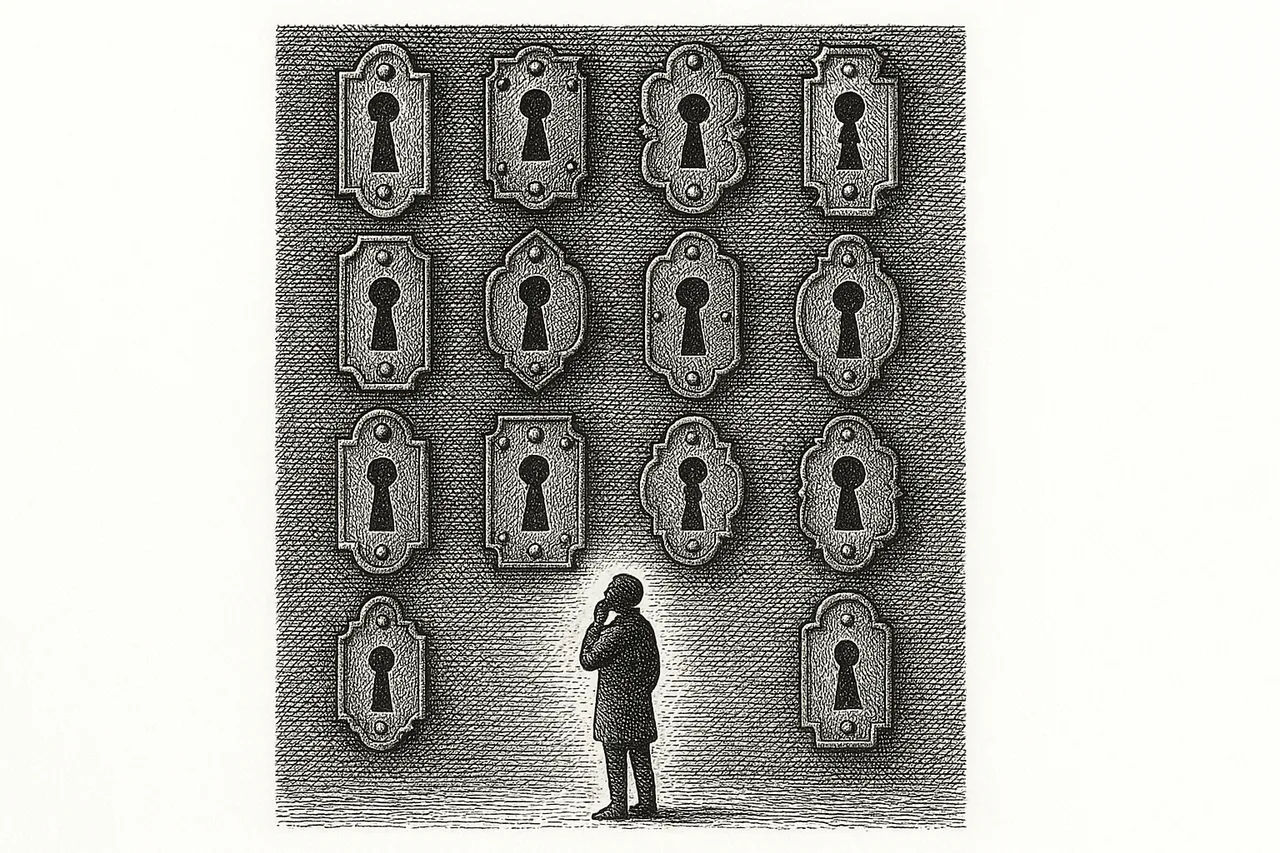
The most popular advice about the 16 personalities test is also the least useful. Take the test, get your four letters, read a flattering profile, feel seen, move on. That's fine if all you want is a polished label. It's useless if you're trying to understand why you keep building the same bottlenecks into your business, your relationships, and your decision-making.
Founders love maps. We love frameworks, dashboards, and tidy abstractions that make a messy system look manageable. Personality tests scratch that itch beautifully. But a founder who mistakes a map for the actual territory usually ends up driving into a hedge.
Table of Contents
- The Map Is Not the Territory
- Decoding the Dimensions for Entrepreneurs
- A Snapshot Not a Life Sentence
- How Founders Weaponise Their Personality Type
- Using Your Results as Questions Not Answers
- From Personality Type to Unconscious Belief
- Your Next Step Into the Territory
The Map Is Not the Territory
A traveller is handed a beautiful map before crossing a forest. The lines are clean. The symbols are elegant. Rivers are blue, paths are neat, danger is politely suggested by contour marks. Ten minutes into the walk, the traveller realises the map omitted the mud, the weather, the smell of pine, the panic of getting lost at dusk, and the strange instinct to turn back just before the clearing.
That's the 16 personalities test in a sentence. It can help you orient. It cannot replace direct contact with your own psyche.
Its popularity makes perfect sense. The test has had viral reach, with over one billion completions globally by 2026, according to Crown Counseling's summary of MBTI and 16Personalities statistics. That scale says less about scientific finality than about accessibility. It gives people a quick language for parts of themselves they've sensed for years but never named.
For entrepreneurs, that can be useful. A founder who struggles with noise, endless meetings, and reactive decision cycles may finally realise they don't have an energy problem. They have an environment problem. Someone who keeps chasing possibilities may recognise a pattern in how they process information, not just a random inability to focus.
But typology has a hidden cost. Once a label gives relief, people start serving the label. They stop observing themselves directly. They start editing themselves into coherence.
The map becomes a cage the moment you stop using it for orientation and start using it for identity.
If you've spent any time around founders who collect frameworks like stamps, you'll know the risk. A model is most dangerous when it feels clever enough to end inquiry. That's why I'd treat the 16 personalities test the same way I'd treat any mental shortcut, including the ones discussed in these mental models for sharper decision-making. Useful, yes. Sufficient, no.
What founders get right and wrong
- Useful: It gives a fast mirror for visible preferences.
- Misleading: It can sound deeper than it is.
- Best use: Early self-reflection.
- Worst use: Defining what you can't become.
Decoding the Dimensions for Entrepreneurs
The letters aren't mystical. They're shorthand for how you currently prefer to direct attention, gather information, make decisions, and organise action. For founders, that's already plenty.

What the letters actually point to
Introversion versus Extraversion is less about whether you're charming at dinner and more about where your system recovers. Some founders process by talking. Others process by withdrawing, then returning with a clearer thought. If you get this wrong, you'll build a calendar that punishes your own nervous system.
Sensing versus Intuition shapes how you scan reality. Sensing founders often notice what's concrete, immediate, and observable. Intuitive founders reach for patterns, implications, and future possibilities. Neither is superior. One catches what's there. The other catches what's emerging.
Thinking versus Feeling tends to show up in how decisions get justified. Thinkers often prioritise internal logic and clean principles. Feelers track impact, values, and relational consequences. In business, the caricature is that Thinking is tougher. That's nonsense. Plenty of feeling-led founders make harder calls because they're willing to absorb emotional complexity without pretending it isn't there.
Judging versus Perceiving often describes your relationship with closure. Judging types usually prefer structure, deadlines, and decisions made in time to act on them. Perceiving types often prefer optionality, movement, and room to adapt. In startups, both can create brilliance. Both can also create chaos.
A decent way to use all of this is to translate type into operating preferences, not identity. That's where resources like this look at entrepreneur personality types become more useful than generic type descriptions, because the key question is never “Who am I?” It's “How do I work under pressure, uncertainty, and ambition?”
Why the fifth dimension matters more than people think
The most interesting part of the 16 personalities test isn't one of the original four pairs. It's the added Identity spectrum, Assertive (-A) versus Turbulent (-T). According to 16Personalities' explanation of its theory, this fifth dimension moderates the others and relates directly to stress resilience. It's also the part many founders accidentally skip past, even though it often explains more about their day to day friction than the four-letter code itself.
A turbulent founder can look wildly productive from the outside while being internally driven by pressure, hyper-vigilance, and perfectionism. That person may not have a “motivation problem” at all. They may have a stress-sensitivity pattern that magnifies every stake, every delay, and every perceived flaw.
Practical rule: If your type description feels accurate but your behaviour still confuses you, look at how you handle stress before you look for a new identity label.
This short explainer is useful if you want a quick visual on how people interpret these dimensions in practice.
The mistake is to reduce Turbulent to “bad” and Assertive to “good”. That misses the point. Turbulent patterns can produce enormous drive, sensitivity, and refinement. Assertive patterns can create steadiness, but also blind spots. In Jungian terms, every strength carries a shadow. The part you admire often drags an undeveloped opposite behind it.
A Snapshot Not a Life Sentence
The cleanest way to think about the 16 personalities test is this. It's a snapshot of preference, not a verdict on essence.

What the test does well
It gives people language. That matters more than critics sometimes admit. Many founders have spent years being told they're too intense, too detached, too idealistic, too blunt, too scattered, too private. Then a profile lands and says, in effect, “There is a pattern here.” Relief follows.
That relief can be productive. Teams communicate better when people have a rough shared vocabulary for energy, workflow, and decision style. Founders also tend to make fewer self-judgements when they realise that some recurring friction comes from preference clashes rather than moral failure.
There's another strength. The framework is memorable. You can recall it under pressure. In the middle of a messy week, “I need less input and more synthesis” is more actionable than a long personality report no one ever reads twice.
Where the model starts to wobble
The trouble starts when usefulness gets mistaken for precision. As CoachHub's review of the 16 personalities test notes, the underlying MBTI framework has mixed results on predictive validity and risks of misclassification. More importantly for inner work, it maps conscious preferences, not unconscious drivers.
That distinction changes everything.
A founder might score as highly organised and future-focused. Fine. But why? One person builds structure because they love elegance. Another builds structure because chaos once felt unsafe. The outward behaviour can look similar while the inner engine is completely different.
A pattern doesn't tell you its origin. It only tells you where to start looking.
There's also the issue of drift. Anyone who's taken this sort of assessment more than once knows the result can shift with context. Mood, role demands, burnout, recent conflict, and even the fantasy version of yourself you answer from can all tilt the outcome.
Here's a grounded way to use it:
- Read for resonance: Notice what feels uncomfortably accurate.
- Ignore destiny language: “You are” is usually less useful than “you tend to”.
- Check context: Ask whether this is your natural preference or your current adaptation.
- Watch identification: If the label gives you permission to stop developing, it's already costing you.
For sceptical founders, that's the sweet spot. Use the test as a mirror. Don't hand it the keys to your identity.
How Founders Weaponise Their Personality Type
Founders rarely misuse the 16 personalities test because they're foolish. They misuse it because the label is convenient.
The excuse dressed up as insight
“I'm an introvert, so I'm bad at sales.”
“I'm a perceiver, so systems kill my creativity.”
“I'm a feeling type, so I hate hard conversations.”
None of those statements are insight. They're identity-protective stories. The type becomes a polished excuse that lets someone avoid the exact stretch that would mature them.
This is especially common among founders trying to build a public presence. A person reads a type profile, pulls out the flattering bits, and turns them into a brand persona. Then they confuse persona management with actual self-knowledge. If you're building a business around your thinking, your story, or your leadership style, it's worth studying how others approach monetizing expertise with a personal brand. Just don't let the branding exercise harden a temporary pattern into a permanent self-concept.
The type is meant to describe a tendency. Ego turns it into an alibi.
The same thing happens in relationships and team leadership. A founder who sees themselves as the “visionary intuitive” starts treating detail as beneath them. Another who prides themselves on being rational uses that identity to avoid emotional nuance, then wonders why the team withholds information.
Why this gets riskier in teams
This gets more serious when personality language enters hiring and team design. A 2023 UK CIPD survey found that 18% of HR professionals use MBTI-based tools, with around 50% of people getting a different type after five weeks, while 42% of UK startup founders seek such tools to manage unconscious bias, according to the cited summary in this 16Personalities roles article reference. That's the danger zone. People want a neat tool for a messy human problem, and they often reach for it right where the cost of being wrong is highest.
If you've ever worked with a founder who sorts people into “our kind of type” and “not our kind of type”, you've seen the downstream effects. Team friction gets psychologised instead of addressed. Poor role design gets blamed on personality mismatch. Someone's people-pleasing, conflict avoidance, or approval-seeking goes unnamed because everyone is busy talking in letters. If that pattern sounds familiar, people-pleasing in business usually explains more than a type code ever will.
Using Your Results as Questions Not Answers
A good use of the 16 personalities test starts after the result, not with it.

Turn each letter into a line of inquiry
If you tested as Introverted, don't stop at “I need alone time.” Ask what kind of contact drains you. Is it noise, performative networking, unclear boundaries, or the feeling that you must become someone else in the room? In NLP terms, that begins to reveal your meta-programmes. You're no longer just noting behaviour. You're noticing how your mind sorts safety, stimulation, and relevance.
If you tested as Intuitive, examine whether your appetite for possibility is a gift, an escape, or both. Some founders naturally think in patterns. Others retreat into abstraction because concrete execution exposes them to judgement.
If you tested as Feeling, ask whether your relational awareness improves decisions or whether you're over-indexing on harmony at the expense of clarity. The distinction matters. Compassion and appeasement are not the same behaviour.
If you tested as Perceiving, look at your relationship with optionality. Flexibility can be a creative advantage. It can also be a way to delay commitment so you never have to face the grief of choosing one road and losing the others.
A better founder journalling prompt
Journaling can often resemble filing paperwork, with practitioners describing surface events and calling it reflection. A better prompt is one that forces the unconscious to leak into language.
Try this:
- Write the result that felt most accurate. Not the whole profile. Just the line that snagged you.
- Complete this sentence six times: “The advantage of being this way is…”
- Then complete this one six times: “The cost of being this way is…”
- Then go underneath it: “If I stopped doing this, I'm afraid that…”
- Finally ask: “Whose rule does that sound like?”
That last question matters because a lot of personality isn't personality in the purest sense. It's strategy. A child learns what gets approval, what avoids conflict, what earns safety, what prevents humiliation. An adult calls that strategy “who I am”.
Some of your strongest traits may be old negotiations with the world.
Sentence completion psychology proves useful. Hypnotic language patterns do as well, because they bypass some of the tidy conscious editing founders are famous for. The conscious mind says, “I'm just strategic.” The deeper material says, “If I'm not prepared, I'll be exposed.” Very different game.
If you want to sharpen the skill of questioning your own conclusions rather than defending them, resources on how to boost decision-making and problem-solving are surprisingly relevant here. Critical thinking isn't just for markets and strategy. It's also for the stories you tell about yourself.
From Personality Type to Unconscious Belief
The 16 personalities test describes behaviour in the same way weather describes a sky. It can tell you what's visible. It doesn't tell you what pressure system produced it.

The personality pattern versus the hidden driver
Regarding this, Jung becomes more useful than internet typology. Jung's real value wasn't handing people tidy categories. It was his insistence that the psyche contains hidden, compensatory, and disowned material. The shadow doesn't disappear because you have a lovely profile description. It goes underground and runs you from there.
A founder might call themselves a “planner”. Fine. But one planner is animated by craftsmanship. Another is driven by the unconscious belief that mistakes make them unworthy. Both create systems. One feels clean. The other feels compulsive.
A founder might call themselves “adaptable”. Fine again. But one is genuinely fluid. Another has learned never to settle because commitment once felt dangerous. Same surface. Different root.
That's why content that treats the 16 personalities test as the whole story falls short. As noted in this discussion of Myers-Briggs applications and the missing link to deeper patterns, existing material often fails to connect type results to the root causes of entrepreneurial self-sabotage. The most useful question is rarely “What type am I?” It's “What belief makes this pattern feel necessary?”
If you want to understand that mechanism more thoroughly, this piece on the unconscious mind and hidden patterning is closer to the terrain than any personality label.
A side by side comparison
Here's the practical difference between a personality framework and a belief-focused approach.
| Focus Area | 16 Personalities Test | Surreal Experiments Quiz |
|---|---|---|
| Primary aim | Describes conscious preferences and behavioural tendencies | Explores unconscious belief patterns shaping behaviour |
| What it explains well | Communication style, energy preference, workflow tendencies | Repeating self-sabotage loops, hidden assumptions, emotional patterning |
| Typical output | A type profile and trait description | Pattern-based insights with reframes and reflective prompts |
| Best use case | Early self-reflection and team language | Deeper inquiry into why success still feels blocked |
| Main limitation | Can be mistaken for identity or destiny | Requires honesty and willingness to examine uncomfortable material |
Founder's test: If a framework makes you feel understood but not changed, it's probably describing the surface.
NLP sharpens this further. Instead of asking what trait you have, it asks what internal strategy creates the trait. What do you delete, distort, and generalise? Which meta-programmes are active? Are you moving towards gain or away from pain? Do you sort by similarity or difference? Do you need internal proof before acting, or external permission?
That's where meaningful change starts. Not with a better label. With a more accurate encounter.
Your Next Step Into the Territory
The 16 personalities test has probably done its job by now. It gave you a rough sketch of your visible preferences. Useful. Better than wandering blind. But if you're a founder who's already read the books, taken the tests, and still keeps hitting the same invisible ceiling, you're no longer looking for a map. You're looking for the machinery underneath the map.
That means examining the beliefs that built the persona.
It means noticing when “I'm just like this” is protecting an old adaptation.
It means being willing to meet the parts of yourself that your polished type description leaves out.
Jung would call some of that shadow. NLP would call some of it strategy. Ericksonian work would notice the trance states you enter without realising. Somatic work would ask what your body already knows before your conscious mind catches up.
If you're ready for that level of inquiry, start with something less flattering and more revealing than a personality label. Start with your patterns. Then take them somewhere deeper through reflective work such as shadow work for entrepreneurs and creatives.
If the 16 personalities test gave you a useful sketch but not the root cause, explore Surreal Experiments. It's built for entrepreneurs and creatives who want to uncover unconscious patterns, decode self-sabotage, and work with deeper material using Jungian psychology, NLP, hypnotherapy-informed prompts, and AI-guided reflection.
Continue reading
Explore the full Personality Tests & Self-Assessment pillarRelated
Read next
Personality Tests & Self-Assessment
Your Personality Test Is Lying to You (Mostly)
Tired of your personality test results changing nothing? Discover what MBTI & Big Five miss and how to uncover the unconscious beliefs that truly run your life.
Personality Tests & Self-Assessment
Master Your Entrepreneur Personality Types
Explore 8 entrepreneur personality types & their shadow patterns. Not MBTI. Learn to use your archetype to grow your business & unlock your full potential.