
How to Do Shadow Work: Unlock Entrepreneurial Growth
How to do shadow work: A practical guide for entrepreneurs. Leverage Jungian psychology, NLP, & somatic exercises to unlock profound growth.
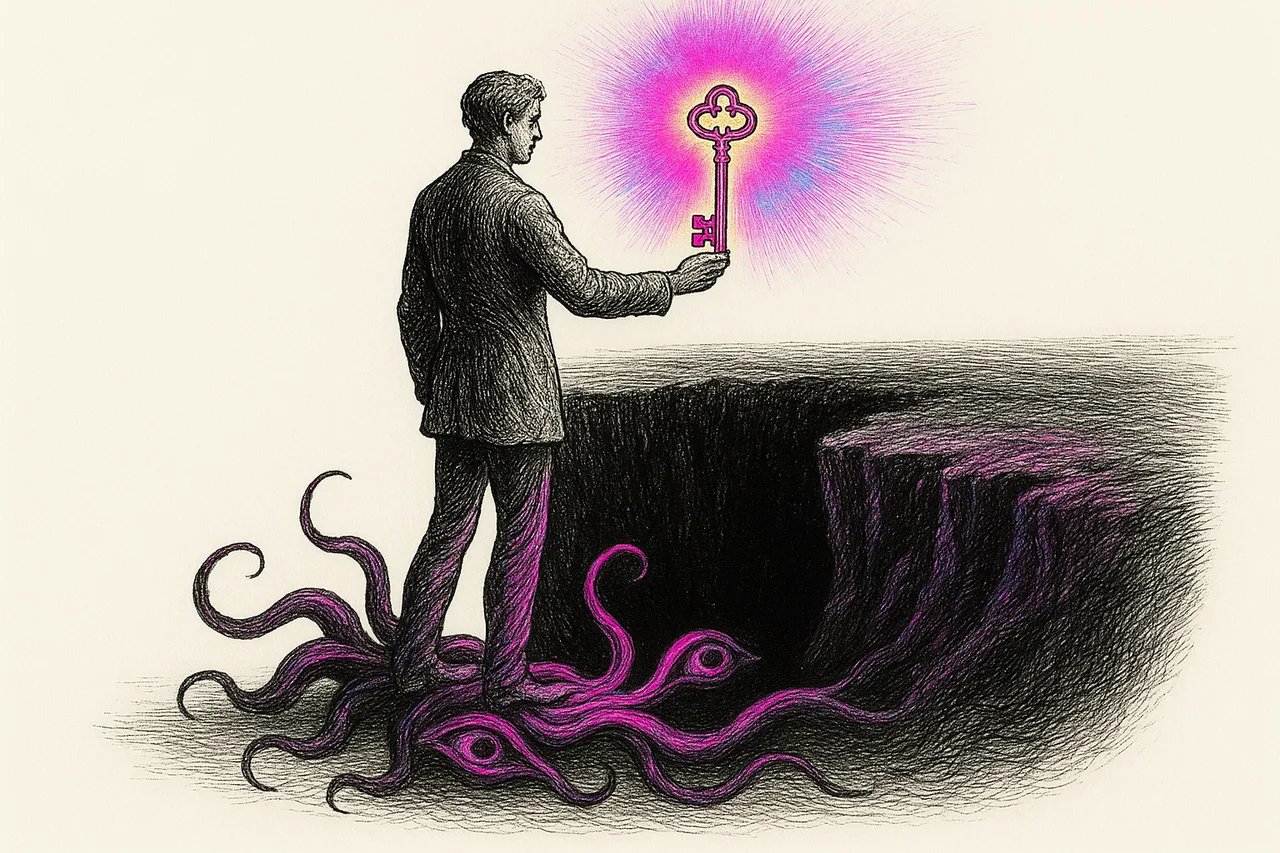
Most advice on how to do shadow work is too polite to be useful. It turns the shadow into a candlelit journalling aesthetic, or a villain to be purified, when in practice it's usually the hidden operator behind your stalled launches, your oddly intense reactions, and the creative force you've edited out to stay acceptable.
That gap matters more than ever. According to Google Search data on the rise of shadow work, public interest in "shadow work" has surged by approximately 92.3% since January 2020, which tells you something important. People are no longer satisfied with surface-level mindset hacks. They want to know why they keep repeating the same pattern, especially when they already know better.
For entrepreneurs and creatives, that question is rarely abstract. It shows up as overthinking disguised as strategy, perfectionism disguised as standards, and avoidance disguised as discernment. If you want more depth before you begin, these shadow work prompts for deeper self-inquiry are a useful companion, but prompts alone won't do the heavy lifting. You need a method that can reach what your conscious mind keeps defending.
Table of Contents
- Your Guide to Shadow Work That Actually Works
- Decoding the Shadow What It Is and Isn’t
- Preparing for the Descent The Entrepreneur’s Pre-Flight Check
- The Shadow Work Toolkit Four Practical Methods
- A Sample Session Taming Entrepreneurial Procrastination
- Integration From Insight to Action
- Conclusion Your Shadow Is Your Greatest Ally
Your Guide to Shadow Work That Actually Works
The shadow isn't the part of you that makes you bad. It's the part of you that was inconvenient.
That's why fluffy advice fails. If your approach to shadow work is just "be loving with yourself" or "write what triggers you", you'll probably get insight, but not much movement. The unconscious is not persuaded by slogans. It responds to pattern, symbol, repetition, embodied attention, and language that slips past the internal censor.
For founders, this matters because your business will faithfully express your unconscious material. A company can become an expensive coping strategy. One person builds endlessly and never launches. Another launches constantly but can't tolerate structure. A third says they want visibility, then vanishes every time attention arrives. None of that gets solved by pretending the issue is time management.
Practical rule: If a pattern survives logic, the pattern isn't logical. Stop arguing with it and start studying its design.
Useful shadow work treats the psyche less like a moral drama and more like a system. Jung gives the map. NLP helps identify recurring filters, meta-programmes, and linguistic habits. Hypnotic approaches help bypass the overcontrolled, high-achieving mind that can explain everything while changing nothing. Somatic work keeps the whole thing honest, because the body usually tells the truth before the brand strategist does.
That doesn't make the work mystical in the vague sense. It makes it practical. You're learning how to spot projection, track emotional charge, decode resistance, and reclaim traits you've split off because they once felt unsafe, unprofessional, needy, arrogant, chaotic, too much, or not enough.
Here's the trade-off. Real shadow work is less glamorous than the internet version. It's slower. Less performative. Occasionally irritating. It will challenge the identity you've built around being self-aware.
It also gives you access to energy you've been wasting on suppression. And that's where things get interesting.
Decoding the Shadow What It Is and Isn’t
Carl Jung gave us the original frame for the shadow self, and the idea has held up because it names something people recognise immediately once they see it. As noted by Cleveland Clinic's overview of shadow work, the concept originated with psychiatrist Carl Jung, and the methodology is now integrated into evidence-based practices like Jungian therapy, which has been shown in studies to yield "significant improvements in symptoms, interpersonal problems, personality structure, and overall functioning".

The part you hid to stay acceptable
The shadow is not just aggression, envy, pettiness, or control. It also includes the beautiful things you had to hide: your ambition, your erotic intelligence, your sensitivity, your hunger for attention, your authority, your weirdness. Anything that threatened belonging can get pushed underground.
That matters because many high achievers misidentify the shadow as only "negative" material. They try to become less selfish, less reactive, less avoidant, which is fine as far as it goes. But often the bigger issue is that they've disowned power. They can't sell cleanly because they equate visibility with arrogance. They can't lead because they equate authority with domination. They can't create boldly because they learnt that being vivid made other people uncomfortable.
If you want a deeper primer on how the psyche hides and reveals these parts, this piece on the unconscious mind and its hidden influence is worth your time.
A short parable about exile
A king once had an advisor who was brilliant, rude, and impossible to manage. He embarrassed the court, questioned sacred customs, and kept pointing out what everyone preferred to ignore. The king, exhausted and offended, banished him.
For a while the kingdom felt calmer. Meetings ran smoothly. Nobody argued. Nobody disrupted the ceremony.
Then the harvests weakened, enemies gathered at the border, and the court kept praising its own wisdom while missing every obvious threat. The king hadn't removed a problem. He'd exiled the part of the kingdom that could smell danger and speak uncomfortable truth.
That's the shadow in a nutshell. What you exile doesn't disappear. It either goes underground and runs things badly, or returns in a form you can work with.
Why talking about it isn’t always enough
Standard cognitive approaches can be useful, but shadow work often needs a different doorway. The issue isn't limited to having an inaccurate thought you can debate into submission. The issue is that a part of you has been organised around protection, image, and survival. It may not respond to argument at all.
That's where other methods matter:
- Somatic attention helps you notice where a pattern lives physically, not just conceptually.
- Projective psychology shows you your disowned traits through your charged reactions to other people.
- Hypnotic language helps loosen rigid identity statements such as "I'm just not the kind of person who..."
- NLP pattern work reveals repeated filters in how you sort experience, especially around control, risk, approval, and certainty.
The shadow can't be managed like a spreadsheet. It responds better when you meet it as a living pattern rather than an error message.
Preparing for the Descent The Entrepreneur’s Pre-Flight Check
Individuals don't fail at shadow work because they lack intelligence. They fail because they approach it with the same mentality they use for inbox zero. They go too hard, too fast, then get flooded, dissociate into analysis, or turn the whole thing into another self-improvement performance.
A better approach is to build a container first.
Build a container before you open the vault
Treat shadow work like deliberate inner fieldwork. Choose a specific time, a private place, and a clear beginning and end. That might mean a notebook, a glass of water, a timer, and a short settling ritual such as breathing slowly and naming the pattern you're here to meet. The ritual itself matters less than consistency. You're training the unconscious to recognise, "This is contained. We go in, and we come back out."
For entrepreneurs, containment also means not doing this in the middle of a hectic workday between Slack messages and sales calls. If your nervous system is already overstimulated, you'll get noise instead of signal.
A simple pre-flight check helps:
- Energy check: Are you tired, wired, hungry, or scattered beyond usefulness?
- Intent check: Are you trying to understand a pattern, or punish yourself for having one?
- Capacity check: Can you stay curious if something uncomfortable appears?
- Exit check: Do you know what you'll do after the session to reorient, such as walking, eating, or speaking to someone steady?
Confidence problems in business often have this same hidden architecture. A founder says they need better sales technique, but the underlying issue is what visibility or rejection activates beneath the surface. That's partly why resources like taap.bio's selling guide can be useful in context. Not because selling is the same as shadow work, but because fear around being seen, judged, or wanting something often sits right under both.
Know the difference between productive discomfort and overload
Good shadow work has friction. It doesn't have to feel soothing. You might feel resistance, embarrassment, irritation, grief, or a very entrepreneurial urge to reorganise your Notion workspace instead. That's normal.
What's not useful is pushing yourself into overwhelm. If you have a history of intense trauma, or if the material starts pulling you into panic, numbness, or extended disorientation, work with a qualified professional rather than trying to win a private endurance contest with your psyche. Cleveland Clinic's guidance on shadow work notes that poorly facilitated shadow work can trigger emotional distress and that qualified professional support can be important, especially when deeper material is involved. That earlier point matters here.
If you recognise yourself in common founder patterns, this overview of entrepreneur personality types and their blind spots can help you choose what to work on first.
Your first job isn't depth. It's stability. Depth without stability turns into fascination, not transformation.
The Shadow Work Toolkit Four Practical Methods
Different patterns need different entry points. Some reveal themselves through language. Some through the body. Some through projection. Some need a clean pattern interrupt before they'll release their grip.
A flexible toolkit works better than one sacred method.
To orient yourself, this visual gives the broad overview:

Method one Projective journalling and sentence completion
Projection is one of the fastest ways to find shadow material because the psyche loves outsourcing. It takes a trait you've disowned and helps you notice it "out there" in other people, where it feels safer to judge.
Start with someone who reliably gets under your skin. Then write without censorship.
Useful sentence stems include:
- I can't stand people who...
- What bothers me most about them is...
- If I were completely honest, what they remind me of is...
- The part of me that is secretly similar is...
- If I had permission to be more like them, I might...
Don't aim for moral clarity. Aim for charge. The strongest material often sounds petty, unflattering, or childish at first. Good. That's usually where the live wire is.
If you want to intensify the exercise, follow each sentence with "and that's bad because..." until you hit a core belief. This borrows from sentence completion psychology and works well because it outruns the polished self.
Method two Somatic dialogue
Some patterns don't reveal themselves through words. Ask a founder why they're avoiding a launch and they'll give you six strategic reasons. Ask where the resistance sits in the body and you'll often get the truth.
Choose one current pattern. Close your eyes and locate it physically. Throat tightness, pressure in the chest, a drop in the stomach, heaviness behind the eyes, frozen shoulders. Then treat that sensation as meaningful rather than inconvenient.
Ask:
- If this sensation had a shape, what would it be?
- If it had a voice, what would it say?
- What is it trying to prevent?
- What does it need me to know before it relaxes?
The aim is not to force the sensation away. It's to discover the protective logic beneath it. Very often the body is holding a non-verbal rule such as "If I move, I'll be exposed" or "If I finish, I'll be judged".
A related practice many people find helpful is feeding your demons as a trauma release exercise, especially when a pattern feels more like an inner figure than a thought.
This kind of image-based work can also be surprisingly vivid when externalised. Some practitioners use sketches, voice notes, or even tools that generate hyper-realistic video to give symbolic form to recurring inner characters. That can sound eccentric until you realise the unconscious already thinks in images.
Method three The 3 2 1 process
The 3-2-1 Shadow Process is useful when projection is obvious and you want a more structured route back to ownership. According to this write-up of the 3-2-1 Shadow Process, a pilot study of 150 London entrepreneurs found that 72% reported reduced procrastination and 81% noted clearer decision-making after four weeks of consistent practice.
The structure is simple enough to use without turning it into dogma:
Third person, "it"
Describe the person or trait you're reacting to as an object of observation. "It is arrogant. It takes up too much space. It doesn't care what anyone thinks."Second person, "you"
Speak to it directly. "You make me furious. You act like rules don't apply to you. What do you want?"First person, "I"
Re-own the quality. "I am the part that wants freedom from approval. I am the part that would like to take up more space."
This shift matters because projection loosens when the trait becomes yours again. Not as a confession. As a reclamation.
Before trying it, a grounded explainer can help. This video is a useful companion for the overall terrain of shadow work:
Method four NLP reframing and pattern interrupts
Once you've identified the shadow logic, you often need a clean interruption. Insight alone doesn't always update behaviour.
A classic Bandler-style move is to catch the internal movie that plays before the old pattern takes over. Maybe you imagine the launch failing, people smirking, or someone saying, "Who do you think you are?" Notice the image qualities. Is it close, loud, vivid, looming? Then alter the submodalities. Push it further away. Drain the colour. Shrink it. Add absurd music if that helps. Replace it with a sharper, more compelling image of yourself acting with grounded certainty.
This isn't magical thinking. It's pattern work. The nervous system often responds to the form of representation before it responds to content.
Field note: If a reframe feels fake, it usually is. Use language your system can accept. "I can learn to tolerate visibility" lands better than "I am a fearless icon" if your body is currently saying absolutely not.
A Sample Session Taming Entrepreneurial Procrastination
Procrastination is rarely laziness. More often it's a negotiation between the part of you that wants expansion and the part that thinks expansion is dangerous.
Take a familiar scenario. A founder needs to publish a sales page for a new offer. Instead, they rewrite the headline fourteen times, tidy their desktop, answer low-stakes emails, and suddenly feel a powerful desire to research fonts. On paper it looks ridiculous. Underneath, it's organised.
The pattern under the pattern
Start with the observable behaviour. "I'm delaying the launch." Then get more specific. Delaying usually protects against something.
In a shadow work session, the first question isn't "How do I become disciplined?" It's "What am I avoiding by not finishing?" Journal until the polished answer breaks. Often what appears is something like this: If I launch and nobody responds, I have proof I'm not as good as I think. Or: If I launch and it goes well, people will expect more from me. Perfectionism often hides between those two fears, fear of exposure and fear of responsibility.
Then move to the body. Ask where the resistance lives. Maybe it's a clamp in the solar plexus. Maybe it's a fog in the forehead. Let it speak. It might say, "If this goes out, we can be judged." That's not irrational in the moral sense. It's protective in the nervous-system sense.
Next comes the re-owning move. Instead of saying, "Part of me is sabotaging success," say, "I am protecting myself from being seen before I feel invulnerable." That sentence is more honest, and honesty is useful because it gives you something real to work with.
If self-sabotage is a recurring theme, this guide on how to stop self-sabotage adds a wider behavioural lens.
Sample Shadow Work Session Template
| Phase (Time) | Action | Example Prompt or Technique |
|---|---|---|
| Settle in | Create a container | Sit somewhere private, slow the breath, name the pattern: "I'm avoiding the launch." |
| Surface the charge | Projective journalling | "I judge people who launch messy work because..." then complete the sentence repeatedly |
| Find the body signal | Somatic dialogue | "Where do I feel this resistance?" "What is this sensation trying to prevent?" |
| Re-own the projection | 3 2 1 process | Move from "It is needy and exposed" to "You are needy and exposed" to "I am the part that fears exposure" |
| Interrupt the pattern | NLP reframe | Shrink the internal failure movie, then install a steadier image of publishing calmly |
| Close the session | Translate insight into action | Choose one concrete move, such as publishing the draft before further edits |
One practical warning. Don't use the session as a delay tactic. A good shadow session ends with behaviour, whether that's publishing the page, sending the email, or making the call. Otherwise you've just built a more intellectual form of avoidance.
Integration From Insight to Action
The glamorous moment in shadow work is the insight. The useful moment is what happens on Tuesday when you have to behave differently.
That gap is where many lose the value. They uncover a pattern, feel a wave of recognition, maybe cry, maybe laugh, maybe tell a friend they've found the root of it. Then they drift back into the same routine with slightly better vocabulary.

What integration actually looks like
Integration means building a bridge between the reclaimed part and ordinary behaviour. If you've realised your procrastination protects you from judgement, the next move isn't more analysis. It's practising being seen while imperfect. If you've discovered that your "professionalism" hides fear of desire, integration may mean making cleaner offers and tolerating the discomfort of wanting to be paid.
Structured protocols can help here. According to Nick Wignall's overview of Shadow Mapping, a 2024 UK Mental Health Foundation survey of 320 entrepreneurs reported a 67% success rate in overcoming entrepreneurial overthinking and a 78% reported enhancement in somatic intuition for business decisions. The detail that matters is not the statistic alone. It's that integration works better when you give the insight a repeatable shape.
Try translating each discovery into one of these forms:
A behavioural experiment
"I will publish before I feel finished."A revised identity statement
"I can be visible without being performative."A somatic cue
Hand on chest, slower exhale, unclench jaw before pressing send.A language interrupt
Replace "I need certainty first" with "I need enough safety to move."
People exploring altered states often recognise this too. Insight can be dramatic, but integration is what decides whether anything changes. If you're interested in broader reflections on how people explore profound internal shifts, the same principle applies. Big experiences don't remove the need for grounded follow-through.
What derails the process
Two traps show up repeatedly.
The first is spiritual bypassing. You have a compelling insight and use it to excuse inaction. "I'm not avoiding the proposal, I'm respecting my nervous system." Maybe. Or maybe you're dressing up fear in clever language.
The second is over-identification. You find a shadow trait and suddenly make it your whole personality. "I'm just very avoidant." That's not integration. That's a new costume.
Insight should make you more flexible, not more fixed.
A better standard is simple. After shadow work, are you a bit less reactive, a bit more honest, and a bit more capable of clean action? If yes, the work is landing.
Conclusion Your Shadow Is Your Greatest Ally
The point of shadow work isn't self-improvement in the cosmetic sense. It's self-retrieval.
When you learn how to do shadow work properly, you stop treating your inner life like a branding problem. You stop asking how to appear healed, evolved, or optimised, and start asking a better question. What part of me have I been refusing to know, and what is it costing me to keep it underground?
For entrepreneurs and creatives, that question has real consequences. The shadow shapes how you lead, sell, create, choose, delay, idealise, and retreat. Ignore it, and you'll keep building strategies on top of hidden resistance. Work with it, and some of that trapped energy comes back online as discernment, nerve, authority, humour, and invention.
The process isn't tidy. Some days you'll uncover something sharp and useful in twenty minutes. Other days you'll discover that your so-called "clarity" was just control wearing a nicer outfit. That's normal. This is ongoing work, not a personality upgrade you complete once and file away.
What matters is that you stay in relationship with what you've exiled. Curiosity beats condemnation. Precision beats vague positivity. Embodiment beats endless interpretation.
Your shadow is not the enemy of your potential. In many cases, it's the locked room where your potential has been waiting.
Stop trying to destroy the parts of you that learned to protect you. Learn their language. Renegotiate their job. Then put them to work.
If you're ready to go beyond insight and start identifying the hidden patterns shaping your business and behaviour, Surreal Experiments offers educational tools for self-discovery, including an unconscious pattern self-assessment and AI-guided reflection designed for entrepreneurs, founders, and creatives who want depth rather than generic mindset advice.
Continue reading
Explore the full Shadow Work: Discover Your Hidden Self pillarRelated
Read next

Shadow Work: Discover Your Hidden Self
The Anger I didn't know I had
Anger doesn't disappear when you suppress it. It stores in the body. A first-person account of finding suppressed anger and the workshop that released it.

Shadow Work: Discover Your Hidden Self
Shadow Work Prompts: 50 Questions to Surface What You've Been Avoiding
Fifty shadow work prompts in eight themes (family, anger, envy, money, desire, intimacy, mortality) to surface what you've been avoiding.

Shadow Work: Discover Your Hidden Self
Feeding Your Demons: A Trauma Release Exercise From Tibetan Chöd
A 6-step embodied protocol for processing the parts of yourself you've been avoiding. From Tibetan Chöd, IFS, and 5Rhythms. Includes safety notes.