How to Make Better Decisions: The Unconventional Playbook
Tired of generic advice? Learn how to make better decisions using a practical playbook that blends cognitive frameworks with somatic intelligence and NLP.
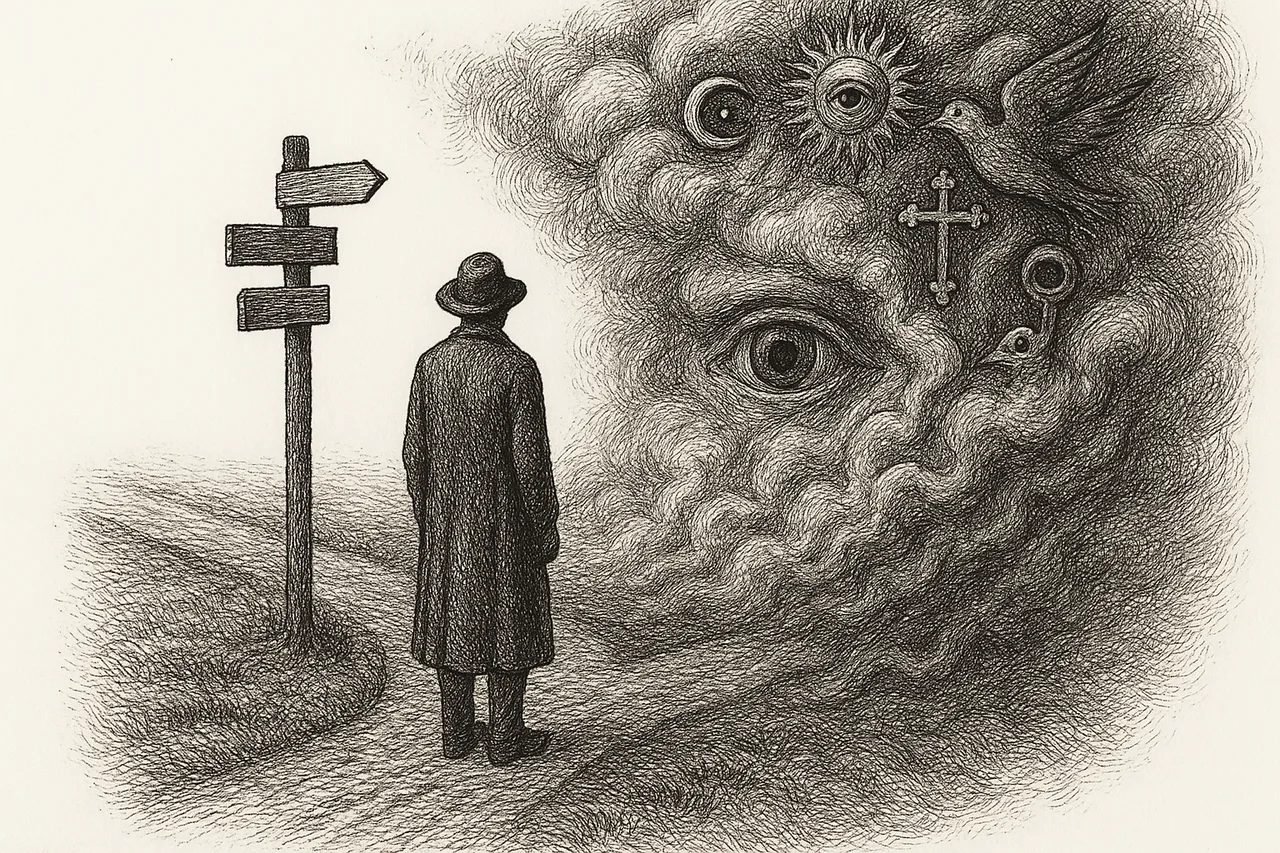
Most advice on how to make better decisions assumes a fantasy version of you. Calm. well-rested, detached, fully rational, staring at a clean whiteboard with a neat list of options. That person rarely exists in real business or real life.
The actual decider is usually carrying hidden loyalties, a tired nervous system, old identity scripts, half-processed fear, and a body that already knows something the spreadsheet hasn't caught up with yet. That's why smart people still stall, override themselves, chase more information than they need, or make a technically logical choice that feels dead on arrival.
A better decision process has to work with the whole system. The analyst. The patterning underneath the analyst. The body that tightens before the mind can explain why.
Table of Contents
- Why Most Decision Advice Is Useless
- The Pre-Decision Audit Your Inner Landscape
- Using Rational Frameworks to Provoke Your Unconscious
- Accessing Somatic Intelligence and Hypnotic Prompts
- Troubleshooting Procrastination and Perfectionism
- Your Next Experiment in Decision Making
Why Most Decision Advice Is Useless
Most decision advice breaks down for one reason. It confuses decision theory with real human behaviour.
A founder choosing whether to hire, pivot, launch, leave a partnership, or raise prices isn't only comparing options. They're also negotiating with identity. Will this make me more visible. Will I disappoint people. Will success trap me. Will failure confirm an old story I've been trying to outrun since school.
That inner layer gets ignored because tidy frameworks look respectable. Pros and cons lists. scoring grids. weighted matrices. They're useful, but only after you admit the instrument is being played by a nervous system, not a machine.
There's a useful UK clue here. In a study on personal decision-making, the Office for Statistics Regulation found that people often start with personal experience, friends and family, and reviews, yet when they're shown specific options in a decision context, they're more willing to use official statistics over online reviews for important choices (Office for Statistics Regulation on statistics in personal decision-making). That gap matters. People say they want data, but they often begin with instinct and social proof. Strong decision-making bridges both.
A short parable explains the problem better than another productivity framework. A master cartographer spent years drawing flawless maps of known territories. Then he sailed somewhere new and nearly got his crew stranded because he trusted the old map more than the coastline in front of him. The map was elegant. The land was real.
Your logic can become that old map.
Better decisions come from a more accurate map of the decider, not from a prettier template.
That's also why borrowed “mental models” only get you so far. They sharpen thinking, but they don't automatically expose the motive hiding underneath the thought. If you want the strategic version of that idea, this piece on mental models from Buffett, Bezos and Jobs is worth reading alongside the deeper psychological layer.
The Pre-Decision Audit Your Inner Landscape
Before you weigh options, audit the person doing the weighing.

Most high-achievers get sloppy here. They analyse the market, the offer, the partner, the timing. They don't analyse the lens through which they're perceiving all of it.
That's dangerous because uncertainty is normal, especially for small businesses. At the start of 2025, 99.9% of the UK's 5.5 million private businesses were SMEs, and many are operating with limited data (analysis referencing UK SME conditions and uncertainty). In that environment, unconscious beliefs can jam the process long before a lack of information does.
Start with the shadow, not the strategy
Jung's shadow isn't a gothic metaphor. It's the part of you that holds motives, impulses and fears your conscious identity would rather not claim.
The polished operator says, “I just need a bit more time to think.” The shadow may be saying, “If this works, people will expect more from me.” Or, “If I choose publicly, I lose the safety of staying undefined.”
A useful pre-decision prompt is sentence completion. Write fast and don't edit:
- If I choose this path, what I'm avoiding looking at is...
- What I don't want to admit about this decision is...
- The version of me this choice threatens is...
- The secret benefit of staying stuck is...
Those lines tend to bypass the executive persona and expose the hidden payoff of indecision.
Notice your NLP meta-programs
NLP offers a practical lens here. Meta-programs are habitual filters for attention and motivation. Two matter a lot in decision making.
| Pattern | What it looks like in decisions | Trade-off |
|---|---|---|
| Toward | You focus on gain, expansion, possibility | You may ignore practical risks |
| Away from | You focus on avoiding pain, loss, exposure | You may overvalue safety and delay |
Neither pattern is wrong. The trouble starts when you think your preference is reality. A strongly away-from founder may call themselves “careful” while their team experiences them as chronically late. A strongly toward founder may call themselves “visionary” while everyone else is cleaning up preventable mess.
Useful test: ask whether you're pulled by a compelling future or pushed by the need to avoid discomfort. The answer changes how you should evaluate the choice.
There's another pattern worth catching. Some people sort information internally. They trust their own criteria first. Others sort externally. They rely heavily on authority, praise, consensus, or criticism. If your decision changes every time you get fresh input, you're probably over-indexing on external sorting.
Audit the evidence you're feeding your mind
Your unconscious forms patterns from repeated inputs. If you're reviewing your own meeting notes, voice memos, and scattered reflections before a decision, clean recall matters. In practical terms, tools that streamline interview recall with notes can help when you need to revisit what was said rather than what your stressed memory reconstructed later.
A simple audit before any important decision:
- State the decision in one sentence. If you can't, the question is still muddy.
- Name the feared consequence of each option. Not the public version. The private one.
- Identify whose voice is in your head. Mentor, parent, market, partner, old peer group.
- Separate facts from identity threats. These get mixed together constantly.
- Check your baseline patterning. Are you trying to choose from clarity or from contraction?
If you want a structured way to identify your own hidden behavioural filters first, the Surreal Experiments assessment is built around that layer of pattern recognition.
Using Rational Frameworks to Provoke Your Unconscious
While rational tools are excellent, they rarely succeed at the task they are commonly expected to perform.

A decision matrix won't magically reveal truth. What it can do is provoke reaction. That reaction is gold. It shows you where your conscious logic and unconscious patterning are misaligned.
Use structure to separate fact from value
In high-stakes settings with incomplete data, UK organisations use structured expert judgment methods such as IDEA, which stands for Investigate, Discuss, Estimate, Aggregate. The method separates technical judgments from value judgments, asks people to express uncertainty quantitatively where possible, and makes assumptions visible enough to audit (structured expert judgment and IDEA).
That principle is powerful far beyond formal organisations. Most messy decisions get messy because people jam two different questions together:
- What do I think is true
- What do I want to be true
Those are not the same question.
When you split them apart, hidden resistance appears much faster.
Try the deliberate tilt
Take a standard tool, then distort it on purpose and watch your response.
If you're choosing between two offers, build a simple matrix with criteria such as revenue potential, operational complexity, visibility, energy cost, and strategic fit. Then artificially weight one option in its favour. Not because the weighting is correct, but because your body will often reveal disagreement before your mind explains it.
If you feel instant relief, dread, annoyance, or a strange surge of clarity, pay attention. That's not noise. That's signal.
A practical sequence:
- Run the matrix cleanly. Keep the criteria ordinary and concrete.
- Tilt one variable. Make one option “win” more clearly than it naturally would.
- Watch for the micro-reaction. Relief, heaviness, resentment, excitement, numbness.
- Write the first uncensored sentence. “I don't want to lead this.” “I'm attracted to prestige, not fit.” “I'm pretending this is scalable because it sounds clever.”
Use a pre-mortem for emotional data
The classic pre-mortem asks you to imagine the decision has failed. Most people stop at risk analysis. Go one layer deeper.
Ask: When I imagine this failing, what part of me feels relieved?
That question catches a lot. Sometimes the choice is failing in your mind because your system never wanted it. The “failure scenario” exposes the burden you were preparing to carry.
Some decisions look rational because they protect an image. Your unconscious usually knows the difference between a real desire and an impressive costume.
If you want a symbolic route into the same territory, Jungian methods such as active imagination can be surprisingly sharp. This guide to active imagination and Jungian metaphor work gives a useful frame for decoding the images and inner characters that appear around a decision.
Accessing Somatic Intelligence and Hypnotic Prompts
There's a point where more thinking makes the decision worse.

That isn't anti-intellectual. It's just accurate. Your body is often registering load, threat, congruence, resentment, or expansion before your language catches up. If you ignore that channel, you end up making polished decisions that your whole system quietly refuses to implement.
This matters even more under strain. In 2023/24, the UK's Health and Safety Executive estimated that 776,000 workers experienced work-related stress, depression or anxiety, with 16.4 million working days lost for the same reason (decision-making under pressure with UK stress data referenced). If cognitive load is already high, adding more frameworks can make you feel virtuous while your judgment gets worse.
Run a somatic check before committing
You don't need incense, a gong, or a personality transplant. Sit still and bring one option to mind at a time.
Ask yourself:
- What happens in my chest when I say yes to this
- What happens in my throat when I imagine speaking this decision aloud
- What happens in my gut when I picture the first week after choosing it
- Do I feel more organised, more collapsed, more braced, or more available
Don't interpret too quickly. Just notice.
A common pattern is this: the mind says yes because the option is impressive, but the body goes dense and narrow. Another pattern is subtler. The body doesn't light up with excitement, but it does feel steadier, cleaner, and less split. For grown-up decisions, that second signal is often the better one.
Use hypnotic language to bypass the censor
Milton Erickson's style of hypnotic communication worked because it didn't force the mind into argument. It invited response from a deeper level.
Sentence completions work well here because they create just enough structure for the unconscious to speak without over-directing it. Set a timer, write quickly, and don't correct your grammar.
Prompt set:
The part of me resisting this decision wants me to know...
If I fully commit, the secret cost will be...
If I delayed this choice for another month, I'd be protecting...
What feels unsafe about getting what I say I want is...
If this decision had a voice, it would say...
These prompts often reveal identity conflicts rather than surface objections. “I'll lose freedom.” “I'll become visible.” “I'll have to stop pretending I'm still exploring.” “I'll outgrow a role that currently makes other people comfortable.”
That's useful material. You can work with that.
For people who want to sharpen emotional discernment alongside somatic data, this piece on mastering EQ for better decisions complements the process well.
Give the body enough safety to tell the truth
The body doesn't speak clearly when it feels cornered. If you're exhausted, over-caffeinated, under-slept, socially flooded, or fresh from conflict, your signals get noisy.
A few practical rules help:
- Reduce input first. Don't seek three more opinions when you already know the pattern.
- Change the state before the choice. Walk, breathe, lie on the floor, reset your visual field.
- Leave low-stakes choices smaller. Save your best attention for the decisions that shape direction.
- Return to the body after analysis. If the spreadsheet says yes and your whole system says no, investigate the split.
A useful companion approach is symbolic externalisation. This practice of feeding your demons through a guided inner dialogue shows how to engage resistant parts without trying to crush them.
For a short reset before using the prompts, this can help:
Troubleshooting Procrastination and Perfectionism
Procrastination is rarely a time-management problem. It's usually a signal conflict.
Part of you wants the outcome. Another part predicts a cost. More scrutiny. more exposure. more demand. more finality. So you call the stalemate “needing clarity” and keep researching.
Perfectionism works similarly. It sounds disciplined and often gets rewarded socially, which is why people cling to it. But in practice it often functions as a protective delay mechanism. You can't be judged for the thing you never fully release.
Track the drag, not just the decision
McKinsey reports that executives spend 37% of their time making decisions, and more than half of that time is ineffective. It also reports that organisations making fast, good decisions are 2.9 times more likely to outperform their peers (McKinsey on decision-making in the age of urgency). That matters because bad decision behaviour often hides in rework, delays, and endless revisiting.
If a decision keeps returning to your desk wearing a different outfit, you don't have a data problem. You have friction in the system.
A simple troubleshooting table helps:
| Symptom | Likely underlying pattern | Useful response |
|---|---|---|
| You keep asking for more information | Fear of being blamed for certainty | Define what information would actually change the choice |
| You revise endlessly | Visibility threat | Decide what “good enough to reveal” means in advance |
| You delay the first move | Identity conflict | Ask who you become if this works |
| You bounce between options | External sorting | Pause new advice and return to your own criteria |
Use NLP pattern interrupts properly
The internet has flattened NLP into motivational slogans. Its value is in changing the internal representation of a problem.
If a task feels oppressive, notice how your mind codes it. Is the image huge, dark, close, loud, and looming. If so, change the submodalities. Push the image farther away. Drain some colour. Turn down the volume of the internal critic. Shrink the mental screen. Add absurdity if needed.
That doesn't solve the strategic issue by magic. It does reduce the emotional charge enough for you to engage with the actual decision.
Try this when you're stuck:
- Freeze the mental picture of the task or choice.
- Describe it precisely. Size, colour, brightness, distance, sound.
- Change one variable at a time. Make it smaller, quieter, flatter, farther away.
- Check your state after each shift. You're looking for reduced resistance, not forced positivity.
- Take one concrete action while the charge is lower.
Procrastination often protects you from a meaning you haven't named yet.
That's why brute force productivity systems fail on intelligent people. They treat resistance as disobedience. Often it's information. Sometimes the task is wrong. Sometimes the timing is wrong. Sometimes the action is fine and the identity implications are what need attention.
If self-sabotage is the recurring pattern underneath your delays, this exploration of why we self-sabotage adds a useful layer.
Your Next Experiment in Decision Making
Good decisions rarely arrive as a burst of certainty. They emerge when your thinking, your body, and your deeper motives stop pulling in opposite directions.
That's the definitive playbook.
Audit your inner state before trusting your analysis.
Provoke your unconscious with rational tools instead of worshipping them.
Access somatic intelligence and language patterns that reveal what the polished mind edits out.
Troubleshoot procrastination and perfectionism as protective strategies, not moral failings.

The most useful way to apply this is experimentally. Don't try to rebuild your entire psyche before choosing dinner. Use one technique on one real decision this week.
You might run a shadow prompt before sending a proposal. You might do a somatic check before a hire. You might use a pre-mortem and notice that your relief reveals more than your fear. You might catch that the “perfect” offer is mainly feeding an identity costume you've outgrown.
That's already a better decision process than the vast majority of individuals ever develop.
The right question isn't always “Which option is best?”
Sometimes it's “Which part of me is trying to choose?”
If you answer that sincerely, your decisions get cleaner. Not easier, necessarily, but cleaner, with less theatre, less overthinking, and more alignment between the move and the mover.
If you want help making that process practical, Surreal Experiments offers tools for decoding the unconscious patterns behind overthinking, perfectionism, self-sabotage and stalled momentum. The assessment is a strong place to start if you want a clearer map of your decision tendencies, and the AI coaching tools are useful when you need a sharper mirror than another pros and cons list.
Related
Read next
Coaching for Entrepreneurs & High Achievers
Business Mindset Coaching: Your Path to Entrepreneurial Flow
Stop generic advice. Discover how business mindset coaching works on unconscious patterns to end burnout and unlock entrepreneurial success.

Coaching for Entrepreneurs & High Achievers
How Does Hypnotherapy Work: How Hypnotherapy Works
Ever wonder how does hypnotherapy work? Discover the neuroscience & psychology of rewriting unconscious patterns. Go beyond stage myths for peak performance!
Coaching for Entrepreneurs & High Achievers
What Is a Life Coach? a Guide for People Who Hate Coaches
Wondering what is a life coach, really? We cut through the fluff to explain coaching's role in decoding unconscious patterns for entrepreneurs and creatives.